Saturday, 26 April 2014

Racing Through the Dark: The Fall and Rise of David Millar - David Millar

You say the word ‘Tour de France’ to someone and the chances are that their minds won’t be drawn to the endurance, resilience and glory attached to cycling’s blue riband event; they will instead think of people like Lance Armstrong, Alberto Contador and Floyd Landis.  Drug Cheats.  There is no sport in the world that is more associated or blighted by the scourge of doping than professional road cycling, and it has brought the sport to its knees many occasions.  Heroes have been cut down and records rewritten as champion after champion has been revealed to have been under the influence of performance enhancing narcotics.  We now appear to have reached the other side of the tunnel, but the stain will never truly be removed.

One such man caught out was the British cyclist David Millar.  Before Bradley Wiggins and Chris Froome announced Britain as one of road cycling’s superpowers, Millar was the golden boy of UK cycling.  A Tour De France stage winner and a World Road Race Champion, he seemed destined for Olympic glory and maybe even to be Britain’s first ever Tour de France winner.  That was until in 2004 when he was arrested, admitted to taking EPO – a blood boosting drug – and was banned for two years. Racing Through the Dark: The Fall and Rise of David Millar is his story.

I have said before that I am not usually one for memoirs.  I generally find them self-serving attempts to justify the author’s actions which rarely offer any kind of genuinely interesting insight.  There are a few exceptions to this, and this book is definitely one of them.  Racing Through the Dark is an honest and sometimes harrowing tale of how the youthful idealism of a young up-coming cyclist can be eroded by the dark under-belly of a sport rotten to the core and in doing so asks some very real questions about how we treat dopers in modern sport.


David Millar is that rarest of beings: a drug cheat who came clean (admittedly while under arrest) and who did not spend years lying to the authorities and the world (see Armstrong, Landis etc).  The book is brutally honest – a truly introspective look into the ‘hows’ and ‘whys’ of doping.  He does not seek to excuse, merely to explain.  The book takes us from his early years of broken family and infatuation with the sport of cycling, through his amateur and professional career up to 2011 which was when the book was published.  Millar starts as a torch-bearer of the ‘clean cyclists’; someone who refused to dope even while nearly everyone else around him was, yet eventually he succumbed.  It is profoundly distressing to see such a man broken by the pressures and forces us to question what we would have done?  If the playing field is so tilted and your career depends on success, can you really justify not doping?  As he says: “If the riders, governing bodies, teams, race organisers and media weren't doing anything about it, then what the hell could I, a 20-year-old neo-pro from Scotland, do about it?”

Millar’s honest writing style makes this sometimes quite a hard book to read.  It is not particularly pleasant to see such a man fall in so ignominious a way – yet it is the only way that this book could function; no one wants to read a flattering account of a drug cheat.  So many memoirs are so heavily ghost-written that they contain little-to-no insight, or are so rose-tinted as to be completely opaque: not so this. 

Something that I found myself contemplating while reading the book was about the very system of punishment.  The reason for giving bans for doping is threefold: to deter would-be dopers by showing that their actions have consequences, to take them out of the sport so that clean riders have a fair shot, and to re-habilitate them back into the sport.  In this way it is much like the criminal justice system itself, yet the attitude pervasive in British sport in particular is very much a ‘throw away the key’ mentality.  What Millar represents in this book is a man for whom the system has – eventually – worked; a man reformed through a no-nonsense attitude in his national federation and through the humiliation of being caught and the consequences for his career.  It made me question my own ‘throw away the key’ attitude as well, and a book that makes me question my own beliefs in any way is certainly something worth reading.

This book may now be a little old, but it is still worth a read.   It tails off a little towards the end in his redemption arc, but that is the harshest criticism that I can give it.  Cycling fans in particular will love it, but the story of a flawed, fallen hero is so universal as to make it suitable to anyone.  Much like Millar’s career, it is not always easy but thoroughly worth it in the end.

7.5/10

Favourite Quotes

“The past is as important as the future, but we only live in the here and now.”

“The manner in which one loses the battle can sometimes outshine the victory.”

“What an idiot I'd been. What a spoilt brat. What a bloody fool.”
Read More »

Thursday, 10 April 2014

Life after Life - Kate Atkinson


In The Wizard of Oz, Glinda offers Dorothy some very sound advice: “It's always best to start at the beginning.”  This is not the vogue method in modern literature, with authors liking to start their stories at the end (The Book Thief), the middle (The Secret History) or in an undetermined part of the plot (The Time Traveller’s Wife).  Starting at the beginning has begun to see a little old-fashioned, unimaginative even.   What the latest book on my review list has done is go in the opposite direction, not only starting at the beginning, but going on to re-start at that beginning many times.  This is Kate Atkinson’s much praised new book Life after Life.


Life after Life is one of those books that grabs you right from the synopsis.  It is the story of a girl, Ursula Todd, who dies minutes after being born on a snowy night in 1910.  But what if she hadn’t?  The story briefly relates her death before moving onto this ‘what if’.  She later drowns in the sea as a small child, but what if this hadn’t happened?  This book, at its most basic level, is about these ‘what ifs’.  It is about how a life can be changed after making seemingly innocuous choices.  Ursula’s life shifts from dying during the Spanish Influenza, to an abusive marriage to a school teacher, to dying in the Blitz (several times) to being the wife of a high-ranking Nazi.  Upon every death we are brought back to snowy Middle England in 1910, but this repetitiveness does not become tiring, it grounds us in the new reality before the narrative moves on.

Ursula is dimly aware of these other lives, of her pre-incarnations, but is mostly powerless to stop her respective destinies.  Indeed this story is both a repudiation and confirmation of the very idea of destiny.  The fact that Ursula has multiple ends belies the fact that she is subject to the whims of fate.  Her choices – and the choices of others – set multiple wheels in motion and shows us just how powerless she – and we – are in determining the course of our own lives.  This is in my view the most interesting part of this novel: an examination of just how much control we have over our own fate.

This is the first of Kate Atkinson’s books that I have read, and I have to say that I was impressed.  Even though it has been critically praised, a work of this scope and ambition has always got the ability to divide as much as it pleases, and I can readily understand why some may dislike it.  It does require an investment in time, as it took me around 250 pages before I really understood what the book was about.  Some critics have criticised it for being just a more elaborate version of the Bill Murray film Groundhog Day, and while I can see how they came to this view, I have to disagree.  This book is far more than just a set of circumstances repeating themselves.

If you are looking for a gentle read on a warm summer’s eve then this is not it.  Urusla’s fates are rarely particularly contented, especially as they pretty much all lead to a premature demise.  She is one of the ‘golden generation’ of people whose lives were inextricably caught up in the First and Second World Wars and she struggles to escape either of them with her life intact.  Kurt Vonnegut in a piece giving advice to new authors recommends: “be a Sadist. No matter how sweet and innocent your leading characters, make awful things happen to them-in order that the reader may see what they are made of,” and Atkinson has really taken this to heart in this book.  Ursula, although the same person with the same personality, is shaped and bruised by the winds of fate in this story, and it is this brutal storytelling that compels the reader to keep going.  

This book is one about fate and destiny, and how despite the changing fortunes of Ursula in her many alternate lives, she is unable to plot her own course.  Merida in the Disney/Pixar film Brave dreams of taking her life into her own hands and ‘changing her fate’.  It is Ursula’s complete inability to do that is the cause of all the drama in Life after Life.  This was a tremendously ambitious project and one that I was worried that was impossible to pull off – but that I was largely proven wrong.  The story does take a while to get going and you have to have faith that the author will bring you round.  Once she does, it is an absolute treat.

8/10

Favourite Quotes

 “What if we had a chance to do it again and again, until we finally did get it right? Wouldn't that be wonderful?”

“She doesn't believe in dogs," Bridget said. "Dogs are hardly an article of faith," Sylvie said.”

“Her heart swelled with the high holiness of it all. Imminence was all around. She was both warrior and shining spear. She was a sword glinting in the depths of night, a lance of light piercing the darkness. There would be no mistakes this time.”

“Sometimes it was harder to change the past than it was the future.”

Read More »

Tuesday, 25 March 2014

The Secret History - Donna Tartt (Classic)

There is always danger when you read a book that has achieved a huge amount of praise.  Depending on the individual there can be the instinct to either: 1) Give it undue praise because other respected people have done so and to not reciprocate would make you sound like an ill-educated oaf, or 2) Try to stand out from the crowd and establish credentials as being ‘alternative’ by deliberately not liking it.  Even if one avoids these traps, it is not always easy to remain totally impartial when reading a new book, especially if it is acclaimed.  This, of course, is the central task of any reviewer, and though true impartiality is almost impossible to achieve, it is important to at least be aware of one’s possible frailties and limitations when reviewing something.

Donna Tartt is a very successful author with her latest book The Goldfinch being nominated for and won numerous awards including the prestigious New York Times ‘Top Ten’.  Her career, however, started in 1992 with The Secret History.  Now normally I only review new(ish) books, but this book came highly recommended by many people whose judgement I trust, and so I thought it would be appropriate to give it the full treatment.


The Secret History in many ways defies categorisation but the best that I have found calls it a ‘Whydunnit’.  The story begins by telling us about a murder, who the victim was, and who the perpetrators were.  The narrator appears to have ‘got away’ with the deed but feelings of guilt obviously linger.  This kind of approach where the ending is given away is not unique to Tartt of course – this was famously utilised by Shakespeare in Romeo and Juliet – but her application of it is particularly effective.  The murder itself occurs neatly in the middle of the story giving us half of a story explaining why the murder occurred, and the other describing the aftermath. 

The story focusses around a young man called Richard who comes from a working-class background to study at an elite university in the North-East of the United States.  There he discovers the most elite and selective course: Ancient Greek, which only taught to 5 students at that time.  These 5 were somewhat cut off from the rest of the university as their education was incredibly immersive and so naturally they were all close.  Ancient Greek culture and literature is one of the story's major themes, cropping up in the obvious context of their studies, but also in the make-up of many of the major characters.  I am in no way a student of Ancient Greek theatre, but one of the stories major characters, Henry, has been described in numerous sources as the classic Greek tragic hero, and it is easy to see how such a man would fit into the famous myths that even I am familiar with.

Almost all of the story takes place on the university campus, a place largely cut off from the ‘real world’ and so these characters, ostensibly cut-off from the rest of their contemporaries, find themselves in a world cut-off from a place already cut-off.  The first major development of the story is that Richard’s classmates, minus the eventual murder victim Bunny, accidentally perpetrate a terrible crime.  Both Bunny and Richard are made aware of this and react in divergent ways.  For Richard his loyalty lies to the people that gave him a sense of belonging and home, while Bunny – feeling cut off by the group who never truly accept him – finds it harder to ignore the crime.  This ultimately leads to his death, the major event in the story.

Donna Tartt is an exquisite writer, and this is much in evidence in this book.  This is described by many as a ‘literary’ book, and yet it is incredibly readable.  I have absolutely no time for writers who believe that to be taken seriously they must render their prose as clear as mud.  Tartt proves that you can write with skill, poise and character, whilst also making her meaning accessible to us mere mortals without literature degrees.  Her story has a natural beauty that is impossible to explain – which of course is the essence of true beauty.  The characters are rich and vivid without being caricatures and I can honestly say that the business of reading the story was an absolute pleasure.

Any avid reader of my blog (if they exist) will know that the aspect that I generally pull out from a story is the relationships between the characters, especially familial ones.  This book is no different as it is really a story of ‘found family’.  All of the characters seem incredibly detached from their parents and, in the case of the twins, even on occasion from their siblings.  The idea of the ‘found family’ is very strong here and the shifting dynamic between the friends as the situation in which they find themselves grows increasingly desperate is, for me, the central part of the story around which everything else revolves.  It is this that is the central frame of the story and allows Tartt to hang all of her beautiful description and embellishment.

Having said all of that, this is not the perfect book.  The stem of this novel’s limitations are that it suffers from a classic case of ‘First Novel-itis’.  I see time-and-time again that authors in their first published work go a little overboard in the breadth of coverage, including details and sections that do not really advance the story but are instead included to satisfy the author’s artistic temperament.  This is understandable, most authors have dreamt of being published for years and so the temptation to include the maximum level of detail must be great.  The Secret History is not immune to this problem, though it is largely located in the first half of the story.  This section still has the richness and beauty that permeates the rest, but it just takes forever to get going.  The pacing is just wrong and this is brought into sharp focus by the rest of the story which moves at a wonderful speed.

This issue, however, does not stop this from being a terrific book and one that I would recommend to anyone.  It is one of those books that anyone with an interest in literature must make a bee-line for and I look forward to reading some of Tartt's more recent titles.

8/10

Favourite Quotes“Beauty is rarely soft or consolatory. Quite the contrary. Genuine beauty is always quite alarming.” 

“Does such a thing as 'the fatal flaw,' that showy dark crack running down the middle of a life, exist outside literature? I used to think it didn't. Now I think it does. And I think that mine is this: a morbid longing for the picturesque at all costs.” 

“Some things are too terrible to grasp at once. Other things - naked, sputtering, indelible in their horror - are too terrible to really grasp ever at all.It is only later, in solitude, in memory that the realization dawns: when the ashes are cold; when the mourners have departed; when one looks around and finds oneself - quite to one's surprise - in an entirely different world.” 

“Any action, in the fullness of time, sinks to nothingness.” 
Read More »

Tuesday, 11 February 2014

Eleanor and Park - Rainbow Rowell


Something that really angers me is when people patronise young people in the arts.  Whether it is people like Mary Whitehouse trying to censor Doctor Who or Colorado school boards attempting to ban the reading of John Green’s Looking for Alaska, there seems no shortage of old people, in the name of ‘protecting the innocence of the innocent’ attempting to prevent young people from being exposed to some of the hard realities in this world.  Wrapping people in cotton-wool does them no good and risks creating literature for young people that is so bland that they will never be captivated by the wonderful world of literature.

Young Adult literature has a tremendous duty to produce work aimed at younger readers that does not shy away from the controversial, the cruel or from what will make them cry and there are many books out there that do not fulfil this basic need.  Thankfully, there are a few that do step up and one such is this weeks book: Rainbow Rowell’s Eleaonor and Park.


Occasionally a book comes along that just takes your breath away; something so good, so powerful that you cannot stop thinking about it.  These do not come along everyday, making them all the more special when they do appear.  This is one such book.  This is a book about first love between two social outcasts.  So far, so ordinary.  Park is a half-Korean in-betweener, not hugely popular, but not an outcast either.  He comes from a loving family (ish) and mainly just tries to get through the day without causing too much of a fuss.  This all changes when a new girl comes onto his school bus.  

Eleanor is a truly wonderful character - wonderfully fleshed and nuanced.  She is a 'big' girl, not unhealthily so, but enough to attract comment in our rather judgemental world.  Her home life is hell.  Her step-father is abusive to her mother, her mother is a shadow of her old self and is getting by the best she can - but is weak.  Her father is uninterested.  Her siblings are cowed.  She is alone in a tiny house in a room shared by all her siblings.  She has no escape.  That is until Park comes along.

I am not going to say too much about the plot of the book because you NEED to read it to believe it.  Suffice to say it is far from just another YA love story.  It contains all of the usual ingredients: late-teen boy and girl, difficult high school, parents in the way etc.  But the story is all about the obstacles; the roadblocks placed in the way by society.  They are forced to confront situations that frankly no one should have to face, but least of all people so young.  The description of the abuse suffered by Eleanor at home and at school is close to harrowing.

The style of the story is a dual POV with Eleanor and Park telling alternately the story in a chronological manner.  This works brilliantly as it gives you the sense that you are getting two different novels at once - indeed she could have released the two halves separately and they still would have stood up.  They tell the stories from a position of love and understanding, but also from the fact that they have very different perspectives due to their wildly divergent upbringing.

There is swearing and Rowell doesn't pull her punches in her description of the horror of Eleanor's home-life, but it would be criminal to say this was not suitable for young readers, though maybe not pre-teens.  There is horror in this world: fear and pain, but simply veiling the eyes of the young from it will only make them ignorant of it when it eventually confronts them.  This book is a testament to how love conquers all and how bravery defeats fear, and to reject it just because it says 'fuck' every now would be just the most terrible shame.

Rowell is a very gifted writer, and the way she weaves the story of abuse and fear around this truly beautiful love story is really quite something.  Her characters are sometimes brutal, but never caricatures or stereotypes.  They are recognisable but unique.  This story is quite simply brilliant.  I never thought that I would read a YA adult story as sad and as beautiful as The Fault in Our Stars.  This is as good and then some.

I don't care what you are reading or what you are interested in.  You have to read this book and I mean right now!

9/10

Favourite Quotes

“Holding Eleanor's hand was like holding a butterfly. Or a heartbeat. Like holding something complete, and completely alive.”

“You saved me life, she tried to tell him. Not forever, not for good. Probably just temporarily. But you saved my life, and now I'm yours. The me that's me right now is yours. Always.” 

“Don't bite his face, Eleanor told herself. It's disturbing and needy and never happens in situation comedies or movies that end with big kisses.” 
Read More »

Sunday, 2 February 2014

Sisterland - Curtis Sittenfeld

Many thanks to Transworld Publishers for giving me a review copy off NetGalley

Everyone loves a trier; it is not always enough to do just enough, or even to excel at the things we do well – we need to do more.  It is seen as being brave to do this; a noble charge to go beyond the call of duty and try to do as much as you can.  This can, however, become problematic when it comes to the arts.  Try too much here and things can lose focus and edge.  Of course you want to create something multi-faceted, but there is a line, however hard is sometimes to see and even harder to judge – and Sisterland is right on it.


Sisterland is American author Curtis Sittenfeld’s fourth book and is the tale of a pair of twins: Daisy (who also goes by Kate) and Vi who, for want of a better word, have psychic powers.  It is a story of their lives, from birth to the present day, and shows how these powers affected them, and how two people with such similarities can grow to be such different people, and yet be so similar at the same time.

The story-telling is split between flashbacks that are chronological from their birth and forwards to a few years behind the present, and the story happening in the present where Vi has predicted a massive earthquake to hit their city of St Louis and the drama that occurs from this.  The story flits between them at whim, keeping you on your toes, and contrasting the changing relationship between the sisters in the present and in the past.

Daisy is the ‘normal’ one of the two.  She grows up as a fairly typical teenager, struggling to fit in and finding solace in her serial monogamous relationships with guys she doesn’t hugely like but make her feel safe.  In the present she is a suburban stay-at-home mum with 2.4 kids and a picket fence who spends her life caring for those kids.  To distance herself from her childhood, which was not particularly happy, she goes by her middle name of Kate and given that she takes her husband’s name after being married, this means she has an all-new name in the present – symbolic of her attempts to leave her past behind. 

She is the narrator of the story and this is one the books great strengths.  Kate is not perfect.  I don’t mean that she is basically perfect but makes mistakes thanks to misunderstandings; I mean that in many ways she is actually quite prejudiced and often acts in a malicious way.  She is still a very sympathetic character, but she is greatly flawed, making her a far more interesting character.

Vi is the more eccentric.  Unlike Kate who is ashamed of her powers and tries to wish them away, she embraces them and even makes a career out of them.  She is a little frustrating at times, both for the characters and for the reader, but she is genuine, if selfish.  She was the wild-child of the two: college dropout, drinking and drugs but now is tamer.  Her announcement that an earthquake was to destroy the city forces the two together.

The ‘psychic’ powers that they have are dealt similarly to how Henry’s time-shifting powers are dealt with in Audrey Niffenegger’s brilliant The Time Traveller’s Wife.  This is far from a sci-fi/fantasy book – it is a book about family and relationships that happen to have an element of fantasy as a plot point.  It is left ambiguous how much control they have over it and how it generally manifests itself, though Vi talks of a mystical ‘Guardian’ that speaks to her.

For me the book is at its strongest when dealing with the story in the present.  The story of the media storm surrounding them as the country seems enthralled and amused at this curious tale brings out the differences in the two sisters and how they interact with the world.  It brings out the divisions in what seems otherwise to be a solid marriage and causes the past to collide with present.  The attempts of Kate to live a normal life as a parent of small children while this all goes on is really wonderful, and testament to an author with prodigious talent.  The story has many intermingled one-on-one relationships: Kate and Vi, Kate and her husband Jeremy, Jeremy and his colleague Courtney, Courtney and her stay-at-home husband Hank, and Hank and Kate.  These relationships are all very strong but are deeply personal between each pair and this leads to difficulties as sometimes others feel like they are on the outside looking in.

The flashbacks are vital to the story as they show how and why Kate and Daisy have changed over the years and have reached the position in which they find themselves in the present.  These are well dispersed throughout and are well told but I do feel there are rather too many of them.  Sometimes I feel like Sittenfeld had not decided which was the main part of the tale: the present or the past.  I happen to think that the present was more interesting and thus had to be supported by the flashbacks, but this was not really the case.

The biggest problem with this book, however, is  the amount of issues that Sittenfeld decides to chuck in.  She has a very interesting story here, about family relationships, about how twins can lead diverging lives, about the difficulties of juggling family responsibilities with parenting and living a life, not to mention the psychic powers and how to live with it in a skeptical world – yet she then tries to throw more things into the mix such as racial discrimination through her friend Hank as well as the ethics of abortion among other things.  The book just became a little less tight and lost crucial focus at a time when it really needed to be building to the big finish, and this is a big shame.

That said though I have to say this is still an impressive book.  The plot idea hit on a very interesting concept and this was executed very well.  The characters are rich and well developed and though the story does lack a little bit of realism with regard to the worldwide reaction to the prediction among other things, this can be overlooked.  What I found harder to overlook was some of the superfluous detail, but this does not fully detract from Sittenfeld’s deep breaking down of the dynamics of family life and of the folly of attempting to escape your childhood and your destiny.

7.5/10

Favourite Quotes

“She would say that we create our own reality – that the truth, ultimately, is what we choose to believe”

“That was the nastiest, most elemental math, made no less ugly for its undeniability”

“We all make mistakes, don't we? But if you can't forgive yourself, you'll always be an exile in your own life.” 
Read More »

Tuesday, 28 January 2014

The Rehersal - Eleanor Catton

I am usually intensely distrustful of 'literary' books.  I often find that they put showing-off ahead of telling a good story.  Clever writing techniques do not necessarily lead to good storytelling.  That is not to say that I am a total philistine – I just like my books to be understandable to those of us mere mortals without degrees in English Literature.  The truly great 'literary' books are those that use imaginative techniques and strategies to tell a story, rather than the story being incidental to those techniques.

Eleanor Catton's Man Booker Prize winning book The Luminaries was often damned in some quarters with the compliment "a triumph of style".  I have not personally read it myself, but knowing something of it, I can see how people may come to that conclusion.  This made me a little nervous about giving her debut novel The Rehersal a go, but having done some research I thought it worth a try.

Now first things first: a confession.  I like Ellie Catton (yes I did just call her Ellie).  I was actually interning at Granta Books when The Luminaries won the Booker Prize and had the pleasure of not only meeting her and her partner but we also all went out boozing together.  She is one of the nicest and most genuine people I have ever had the pleasure of meeting and I cannot rule out the possibility that this review may be influenced by her being a gem.


The Rehersal tells two parallel stories: that of an elite, slightly Darwinian, drama school and that of a high school in the grips of a teacher/pupil sex scandal.  All of the characters are like open books, like characters in a play.  They keep very little to themselves and articulate every emotion to each other in a very clear and evocative manner.  It is told in a constantly shuffling time scale, moving between months and years constantly, which makes the plot a little difficult to follow but equally keeping the story moving along at a good pace.  Catton never reveals anything too soon, always ensuring that you are kept guessing.

The central plot point: the affair between Victoria and Mr Saladin is kept secret and mysterious, just as it was to the students in the play and pupils at the school. For the girls at the high school, the affair was a great betrayal of their trust, not because it happened, but that Victoria did not tell them. In that community total secrecy was the taboo. Sex was seen as something that was both intimate between the people involved, but also that deserved public scrutiny - something that is interesting to consider in our world.  Moreover, the characters in the story celebrate crisis: being seen as damaged was desirable and the characters who identify as being 'normal' are outcast which is another really interesting thought that Catton throws up.

The storyline in the theatre school is a little less focussed.  While the descriptions of the lessons and attitudes of the teachers were my favourite parts of the book, I felt that it did not marry well with the rest of the plot.  The spine of the story are saxophone lessons given to many of the main characters by an unnamed teacher who has a seemingly unhealthy fascination with the lives of her young charges.  There is clearly some potent symbolism here, but I was not unable to unearth it: it was possibly a little over my head.


Though at times I felt the book to be a little over my head, I loved this book, especially how the characters are completely open with little thought of social propriety, and the examination it contains of teenage social interaction and life is truly something to behold. While this is not my usual genre, I would recommend this to any reader who is willing to dedicate some time and thought to a book.  Trust me, it is well worth it!

8/10

Favourite Quotes
“She is a loner, too bright for the slutty girls and too savage for the bright girls, haunting the edges and corners of the school like a sullen disillusioned ghost” 

“Remember that anybody who is clever enough to set you free is clever enough to enslave you.” 


“Gaining control isn't the exciting part. Sleeping with a minor isn't exciting because you get to boss them around. It's exciting because you're risking so much. And taking a risk is exciting because of the possibility that you might lose, not the possibility that you might win.” 

“The stage is not real life, and the stage is not a copy of real life. Just like the statue , the stage is only a place where things are made present. Things that would not ordinarily happen are made to happen on stage. The stage is a site at which people can access things that would otherwise not be available to them. The stage is a place where we can witness things in such a way that it becomes unnecessary for us to feel or perform these things ourselves.” 
Read More »

Friday, 17 January 2014

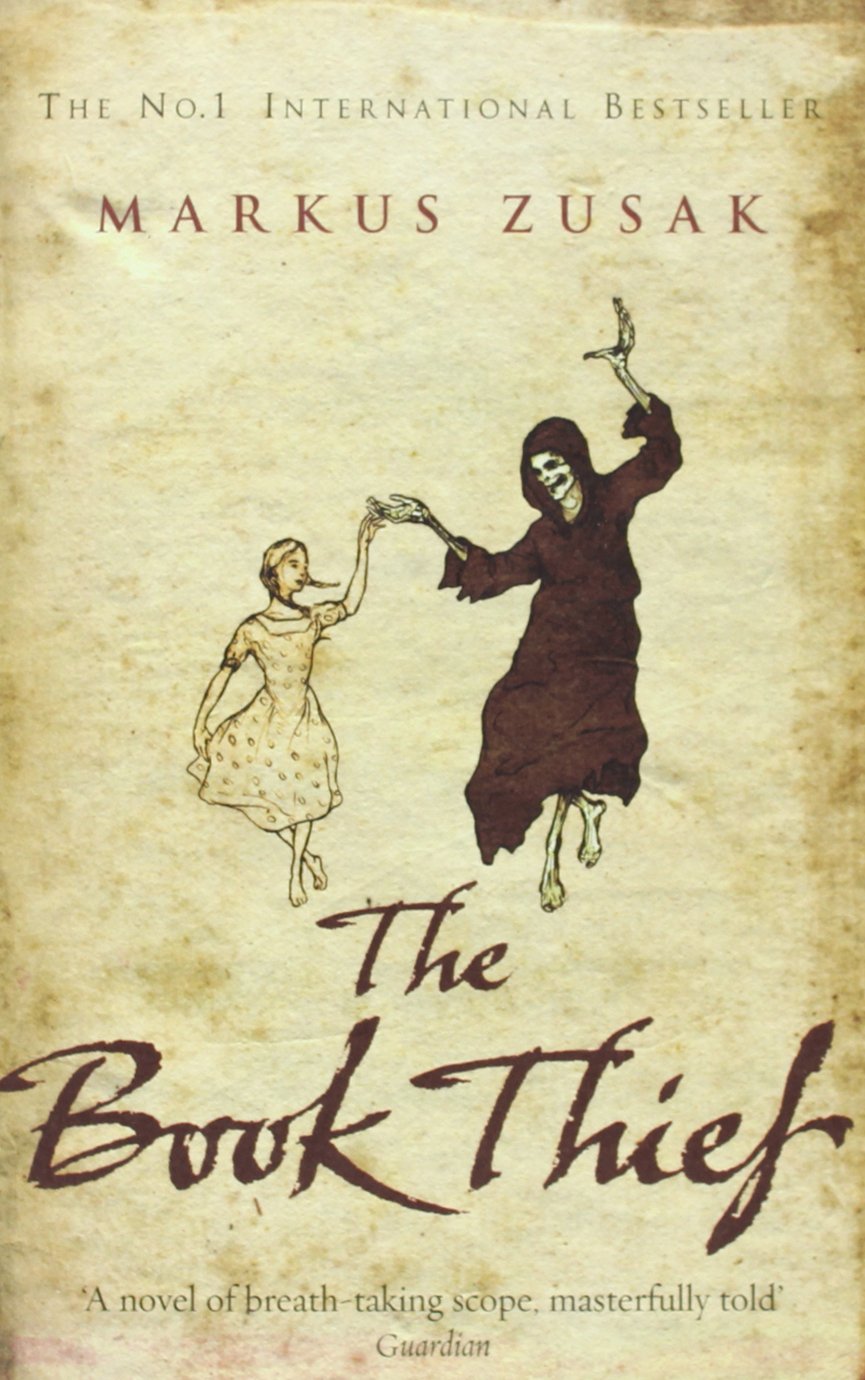
The Book Thief - Markus Zusak

There are some periods of history that are particularly fertile ground for works of fiction or film.  How many books have you read set during the Tudor and Georgian ages of England, the Civil War era of the United States, or Revolutionary France?  These are all times of either great extravagance and change or great violence and upheaval, and in these periods the author doesn't lay a lot of groundwork – we already know.  These settings come with the additional advantage of being in the (relatively) distant past, by which I mean that nobody alive today remembers it.  Yet there is one that is ubiquitously synonymous (at least in the Western world) with suffering, hate and death: Nazi Germany. 

A complete list of books, films and television programs set in Nazi Germany and during the Holocaust is really too long to set out here, but do include such masterpieces as: Schindler's List, The Boy in Striped Pyjamas, Sophie's Choice, The Pianist, The Reader, Life is Beautiful and The Damned.  This is illustrious company to have to match up to, and that is before one considers the moral responsibility to not sully one of history's great tragedies with a mediocre portrayal; it is quite another thing to produce something that not only reaches these lofty heights, but also exceeds many of them yet that is exactly what Markus Zusak does in The Book Thief.


Now I would like to start this review with a couple of personal peeves from other reviews: this is not a Holocaust book.  Yes: it is set in Nazi Germany during The Holocaust, and Yes: it does feature a family hiding a Jewish man in their house, and Yes: The book does deal with the repression and death associated with it BUT calling The Book Thief a Holocaust novel is like saying that 1984 is only state control over the behaviour of its citizens - it is a major theme, but it is about so much more than just that one facet.

I also have another peeve: this is NOT a YA book.  It does feature as its main character a child, but so does Child's Play and I'm not sure anyone is quite old enough to watch that!  While the character of Death does have somewhat of a sensitive and regretful sensibility, that doesn't have to make it YA.  For me, a YA book is one that is marketed at teens.  They generally feature a single main character dealing with the problems of youth and growing up.  They have first kisses and loves, friendship and familial relationships, and experimentations with new experiences.  The Book Thief, though you could at a pinch call it a coming-of-age story, and it does have familial relationships at its heart, is not this.  This is general fiction, marketed and read by all.

Anyway, enough with my rants - let me tell you a little more about this awesome book:

The Book Thief opens with a monologue written by 'Death'.  He talks about the Second World War period being a time of intense activity for him, a period where he was needed constantly.  He portrayed shown largely in the Grim Reaper representation, though he does talk about being rather amused by the archetype.  He then introduces the main character, a young girl by the name of Liesel Merminger, who is given up for adoption by her communist mother who knew that, in her care, she would never be safe.  She is sent to the Munich suburb of Molching to live with the kindly Hans and the foul-mouthed if loving Rosa Hubermann.  As a blonde(ish) Lutheran German pre-adolescent, Liesel is not at risk from persecution - but she still experiences the horrors of the Nazi state and the foreign and domestic wars it waged.

 Liesel is the eponymous 'Book Thief' and steals her first book, the unlikely 'Gravedigger's Handbook' at the cemetery during her brother's burial.  This becomes her link with the past, the only tangible connection to a mother she barely remembers and a brother whose death she dreams of daily.  Her later book thieving is for a very simple reason: to even the score.  She has lost so much – had so much taken from her – that taking books is, to her, the only rational response.  She develops a passion for words, yet it is also words that Zusak presents as being responsible for the death that surrounds her.  She finds herself enchanted by them and driven on just as Germany was enchanted by the words of Hitler.

One thing that really marks this book out is Zusak's style.  By having the story written by someone omniscient, he is able to do what I call 'Mean Intentional Spoiling'.  In this way he is able to tell you a character is going to die several chapters before it happens, which he uses to devastating effect.  You are always kept on your toes and you are never able to feel comfortable reading this book because you have no idea when Zusak is about to drop a bombshell on you, something that does literally happen at one point.  This 'spoiling' is a product of Zusak's style of jumping chronologically about, especially when relating the parallel stories of Liesel and the Jewish refugee Max.  This is done in often a fairly whimsical style but when the author wants to be brutal he does so without remorse

The Holocaust of course rears its head in the narrative, and the main way this is interacted with is through Max.  Max is the son of a soldier who saved Hans (Liesel's foster father) during the Great War and flees his home to the Hubermanns in the wake of anti-Semitic persecution.  He is hidden away from sight and his only interaction with the world at all is through Liesel.  They find that they are kindred spirits: orphans of hate, fascinated by the written word and haunted by their past experience.  They develop a powerful bond, and it is this that I think is the most powerful and beautiful part of the story.

And it is these bonds of friendship and family that are the most important ones in this story.  I haven't talked much about Liesel's relationships with her foster parents or her best friend Rudy because frankly I don't want this review to go on forever, but these relationships are vital.  If books form the trunk of this story, then it is the relationships that Liesel develops that are the flowers and blossom.  It is these relationships, that are borne through a shared suffering but also a shared hope, that are shown as being the most powerful.  In fact it is this friendship that in the end saves Liesel's life.


It should not come as any surprise to anyone having read this far that I absolutely loved this book.  It is not the easiest read, but it is a triumph.  It waded into a topic considered sacrosanct and a setting saturated by brilliant works, but yet it manages to rise effortlessly to the top.  It is quite simply, and utterly, brilliant.

Read it.

Read it now!


9/10

Favourite Quotes
  • "I have hated words and I have loved them, and I hope I have made them right."
  • "Trust me, though, the words were on their way, and when they arrived, Liesel would hold them in her hands like the clouds, and she would wring them out like rain."
  • "The consequence of this is that I'm always finding humans at their best and worst. I see their ugly and their beauty, and I wonder how the same thing can be both." 
  • "Somewhere, far down, there was an itch in his heart, but he made it a point not to scratch it. He was afraid of what might come leaking out."
  • "I guess humans like to watch a little destruction. Sand castles, houses of cards, that's where they begin. Their great skills is their capacity to escalate."
Read More »

Friday, 10 January 2014

Walk Me Home - Catherine Ryan Hyde

We live in a society that demands leadership; that is in love with decisive action.  If you go to your local bookshop and look at any book on self-help title, that's what it'll tell you to do.  Make your mind up and make a decision!  The my favourite one is from Teddy Roosevelt: " In any moment of decision, the best thing you can do is the right thing, the next best thing is the wrong thing, and the worst thing you can do is nothing."  The problem is that most of us are wrong about most things most of the time.  Of course we are, it's how we learn.  What happens though if life-or-death decisions about your life, and that of your little sister are thrown to you when you're just 16?  Well I imagine you'd say you'd be screwed.  Well, that just about summarises my latest book:


Walk Me Home is the latest book by Catherine Ryan Hyde, though it is the first of hers that I have read.  Straddling the divide between YA and Adult Contemporary, it tells the story of Carly and Jen: two sisters who are travelling from New Mexico to California on foot as they flee towards the only responsible adult they have ever known in an attempt to avoid going into care.  Their father is long-since gone, their mother is recently gone (for reasons that are explained later and I will not spoil), and the only adult left in their lives is Teddy - a man who Carly loves and trusts beyond all else, but Jen has reasons to say otherwise - who lives hundreds of miles away and is uncontactable.  They had no money, no transport and frankly no hope. 

After escaping starvation and assaulty/rapey adults (and some nice ones as well) they find a cranky yet kindly old American Indian woman who takes them in despite her catching them stealing from her hen house.  Jen is a fan, Carly is not, leading to the sisters splitting before fate intervening to reunite them at the end.
 
The first thing that I would say about this book is that you have to suspend that part of your brain that tells you that this realistic or believable.  The plot is frankly a little ridiculous and the characters it has to be said are hardly original.  However, there are good facets to this book that I did enjoy.

The first is the drip-drip nature of the story telling.  It is written in a flashback style, with part of the story being told in the present, and the other being about six months in the past.  This means that at the start you have no idea why the girls are fleeing or what it is they are fleeing from.  As the plot progresses then the pieces of the puzzle begin to fit together and you start to build the picture, but just as the girls are confused about what is going on, so is the reader.  they don't know who to trust or who to believe, and likewise neither do you.  To quote Blackadder : "it twists and turns like a... twisty turny thing".

The second facet that I liked brings me back to what I was talking about at the start.  Responsibility was thrust upon Carly as the elder sister but, just like Lizzie Bennet in many ways, she is blinded by her own prejudices.  She hates her mother and doesn't believe a word she ever said.  She implicitly trusts Teddy despite mounting evidence to suggest he is a ne'er-do-well.  She insists on trusting no one else and on keeping on travelling, despite appearances that that may be a little suicidal.  With Carly it's her way or the highway (in fact its more her way AND the highway).  She is incredibly tunnel-visioned, and that is both what keeps her and Jen alive, but also what leads them into great danger.  She doesn't know who to trust, so she trusts no one but Teddy.  While this may not be a terribly original character, she is a very interesting one as she is intensely flawed.

This is in many ways a classic coming-of-age story with a very readable style which never reveals too much; keeping you hooked.   It is a story about 'Home' and where to find it when your life is seemingly lost.  It is a tale of hope and optimism in the face of crushing odds which pushes all of the emotional buttons with more twists than a Cornish country lane.  It's faults are many, focussed around the fact that most of the characters fail to act in any sense rationally, but this does not stop this from being an enjoyable read.

7/10
Read More »

Saturday, 4 January 2014

Unbreakable - Kami Garcia

Anyone who has been to university knows that there are two basic academic groups: the Science students and the Arts students.  There are of course some subjects that straddle this great divide such as Psychology, Geography etc but these are the main two.  Now I hope you will please indulge me if I be a little broad and sweeping.  

In general Science students like facts, numbers, theories, equations.  They like something tangible; something that they can follow so that they can add ‘x’ to ‘y’ and get ‘z’.  They like to ask questions and get definite answers, or at least some kind of an answer – preferably one that can be expressed in a few words.  

Arts students, myself included here, do not like this.  We don’t answer questions: we like to say things like “well to an extent that is true but really there are a number of factors...” We like to pooh-pooh so-called facts, saying lines like “facts get in the way of a good narrative.”  Now this is of course because the kinds of questions that we tackle are not the same: they are creations of man, not of nature.  You can come up with an equation to figure out how fast something falls or what time the Sun will rise in the morning, but you can’t create one to explain what makes Mozart’s music enchanting or JRR Tolkein’s works enthralling.  You can’t express art through numbers, be it music, painting, sculpture or literature, yet this has not stopped people from attempting to work out the formulas to the perfect book – the 5 easy steps to telling a best-selling story – and in my view, Kami Garcia has attempted to do just that.


I won a copy of Kami Garcia’s first solo book Unbreakable from a competition on Goodreads.  I entered the contest not really bothering to work out what it was about, just because I fancied a free book.  The cover of it made it look a little silly but it was free so who cares right?  The book is a YA supernatural story about a girl named Kennedy who was living the kind of life that 14 year old female protagonists of YA books always lead: alone, boyfriendless and angsty about it, bookish and devoted to her parents (or in her case parent).  Her life is suddenly torn apart when a demon, latched onto her cat like a plague flea on a rat, kills her mother and she is only saved by a pair of dashing twins who tell her that she was descended from a secret order of, in effect, demon hunters.  

So we have the stereotypical protagonist, in a stereotypical-ish plot and now we are going to hit new levels of lack-of-imagination: the twins.  They are both teenage boys but have different characters: one is level-headed and sweet but a little dull; the other is handsome, dashing and damaged.  Care to hazard a guess where the love interest of this story lies?  Oh these three are not alone.  We also have the bitchy, fightery girl who sees the protagonist as a liability, and the nerd, the technical support guy who is no threat to the protagonist and is merely there to provide cool things.  

The plot, other than a lot of angsting around, is about demon/ghost hunting, specifically about preventing a powerful demon from escaping into our world and it is up to our motley band of barely trained teenagers to do it.  Think Ghostbusters but 15 years old and with worse stuff.  And meaner demons.

I think you so far get at why I think this book isn’t great: it’s as formulaic in structure and characters as the speed of light.  Indeed the plot, up until the end at least, is so incredibly predictable that anyone in any sense familiar with YA literature could tell me the entire plot from a small number of clues.  The characters in many ways are caricatures, not over-blown in any sense but just perfect tropes.  I won’t spoil the plot for you, but frankly you could guess most of it from here.  The ending is actually quite good and rather salvages the overall plot into something rather decent, but really this book, while not riddled with faults, suffers from the very basic problem that it is entirely formulaic.  It is as if Kami Garcia had distilled every YA book that she had ever encountered into a mathematical formula, created an algorithm, inserted the names of each character trope that she wished to include, and pressed “Go”.

The book is not badly written, nor is it a terrible read: it is just bland as all hell.  You finish the book and feel very little from having completed it because you feel that you have already read it before.  It is incredibly lazy storytelling and in some ways makes me a little pissed off because I have no idea why this was published.  Books these days are churned out in their  tens of thousands every year and yet the industry is still struggling and it will continue to struggle if all they produce is mediocre, middle of the road, formulaic works such as this.  This books really is one of those times where I wish that it had been bad – if it had been bad then at least it would have been original.

4.5/10
Read More »

Monday, 23 December 2013

The Ballad of the Five Marys - Donald Smith

Sometimes when you’re an intern at a publishing house you get questions that you really don’t know how to answer.  These are questions like: “How are you finding your time here?”, “Would it be okay if I asked you to do...” and “Isn’t this cover that I designed fabulous?” which all have very nice and easy answers.  You say: “It’s great, I’m having an amazing time”, “Of course, nothing would please me more” and “It’s beautiful!” and to be honest most of the time you are being truthful because every person that I have worked with so far in this industry has been incredibly friendly and talented.  On occasion, however, the tricky questions come up., the most difficult of which is: “What do you think of this book?” Now this is more than a question of sucking up to the powers that be. You can’t of course be wholly negative, but a sycophantic response praising the book to the rafters is not always appropriate either. You’re trying to show off judgement, taste and maybe a bit of a discerning sense of where the market is.  This means that the normal response is to praise the book but offer reservations. 

Where am I going with all of this?  Well near the end of my first placement with Luath I was given Donald Smith’s The Ballad of the Five Marys to proof-read.  This is a historical-fiction novel set during the life of Mary I of Scotland (the inner historian in me hates calling her Mary Queen of Scots for boring reasons that I will not get into here).  I read through much of the book in one day and was asked how I was finding it.  I, truthfully (often a mistake in work and in love), said that I was really enjoying it and thought it could be, if marketed right, a big seller.  Apparently this was the correct answer (phew!) as the book was quite popular in the office.  However, on describing the novel to some of my friends I have found that people have been quite sceptical about it.  Therefore the purpose of this review really is going to be me attempting to persuade you that this book is, in fact, a really rather excellent historical novel set in a period saturated with a lot of very average works.

The main reason for why I like this book is the style.  Unlike other genres of fiction, I find that historical fiction tends to be a little stuck in its ways. Most books tend to be written in a fairly standard first-person style, focussing on one or two characters’ journey or in a narrative third-person style. This book is nothing like that at all.  It is set throughout most of the life of Mary Stewart, first crowned regnant-Queen of Scots from the time of her birth to her incarceration by Elizabeth I of England.  The story is told through a number of POV accounts, set through a combination of diary/diary-like accounts, personal correspondence and other similar methods.  The idea essentially is to get a widow on the minds of each individual.  The ‘Five Marys’ (four companions of Mary I along with the queen herself) have their own shared diary, form around half of this, the rest being various people from like Darnley and Bothwell.  The author has a strong didactic purpose (something that I will come back to later) and this means that he attempts to get as many different perspectives in as possible, but this does not distract from the story-telling – in fact I believe it enhances it greatly.  As a historian with an interest in the period I am perhaps not the best person to talk about with regard to how the characters come across, but in my view they are differentiated well without becoming generic and all bring their own distinctive flavours to the story.  Equally, one would expect a story that covers such a significant amount of time to rather flounder as time passes, but quite the contrary, I find it picks up pace as the story progresses.

This story’s main weakness, however, lies in its didactic purpose.  The author professes himself to be a big fan of Mary Stewart and intends for the novel to redress the balance of some professional historiography that, in Donald Smith’s view, unfairly maligns her.   For me this is a rather troubling stance to take.  It is true that modern historiography has often shown Mary to be a rather naive queen, whose poor choices in husband led Scotland to a very bloody period of civil strife that dogged not only her reign but also the minority of her son James.  Furthermore, there is a very valid argument that perhaps this line of enquiry can be overplayed; Mary ruled at a very difficult time thanks to the emerging power of England and the turmoil of the Reformation.  Having said all of that, however, for a fictional account to be attempting to pass itself off as some sort of amateur history strikes me as being a little troubling.  It strikes me as being a bit like films such as BRaveheart that have very little grounding in actual history, but pass themselves off as fact.  Now this book has far more accuracy than Mel Gibson’s mauling of history, but it must always be remembered that this is fiction.  Leave history to the pros!  The worst example of this is the final page which lists a group of ‘Discussion Questions’ which seems to suggest that Smith intends for this book to be taught to children in school as History.  I really hope that is not the case as it would mark a remarkable dilution of the subject for a fiction book to be passed off as fact!

Despite this reservation, I would strongly recommend this book to fans of historical-fiction, if nothing else than because stylistically it is so different from anything I have read before in adult fiction.  Ignore the pretentions of historical scholarship and you will find a very pleasing read!

7/10
Read More »