Thursday, 7 August 2014

Black Box - Cassia Leo


The comfort zone is so-named for a reason. It’s secure and familiar – a cosy place to relax to escape from some of the nasty things going on in the world. The problem is that really good literature should draw us away from this happy place. It should challenge our world view and show us new perspectives that make us feel decidedly uncomfortable. It should be free to take on societal taboos and face them square-on.

Black Box does exactly this. Written by New York Times bestselling author Cassia Leo, it takes on the trauma of a victim of an unspeakable crime, and her entirely rational desire to end her life. Mikki suffered a horrific attack in her teens which left her with scars so deep that they overwhelmed her entire life. Attacked by a group of men, physically and sexually assaulted, and then left for dead, she survived only due to the intervention of another victim of a trauma, this one very different. Rescuing her from her near-fatal fate prevented the young musician Crush from ending his own life.

Their meeting was entirely coincidental, but they keep running into each other, intervening at the crucial moment that prevents them from taking the final fatal step. This final time sees them meet at Logan Airport in Boston as their flight to Los Angeles is cancelled due to bad weather. Mikki, having left notes to her family and settled her affairs was prepared to end her life in the Pacific Ocean but the delay and Crush’s intervention means that she is stuck in Boston for a few days. What follows is a whirlwind romance, but also a deep and sometimes brutal examination of what it means to live with a traumatic event.

The theme of the story is the feeling of lost control. The assault on Mikki did not just leave her emotionally brutalized; it ripped away her means to control her own life. Her loss of power of attorney meant that she had legally lost the right to make her own decisions but she had also lost it in a more primal sense. To exist she has to take meds by the handful and even this does not aid her fully. In order to claw back some feeling of control she resorts to actions such as self-belittlement, self-harm, and attempted suicide.

At the core of this novel is the question: what do you do when the only rational course is to end your life? What is the point of living a life that has been ruined? How do you overcome an event that has come to define your entire existence? What is decidedly unnerving about this novel is that you find yourself siding with Mikki on her desire to kill herself. Cassia Leo does an amazing job of conveying not just Mikki’s fragility and vulnerability but also her strength. For her ending her life is not the coward’s way out at all, it is just something that she must do.

I have not spent much of this review so far talking about the other half of this story. Crush (not his birth name), unlike Mikki has, to an extent at least, been able to deal with the trauma of his past and has determined to save her life in the same way that she, unknowingly, saved his. He comes from a world of wealth but has come to resent the privilege that comes with it, and he recognises in Mikki both a kindred spirit but also the intervention of fate – a supernatural force that keeps bringing them together and binding their destinies. Caring, methodical, and understanding, Crush provides Mikki with the support that she never truly got from her family or carers, and thus ignites from this story of trauma and loss, a love story that is tender, raw and dazzling.

Much like The Fault in our Stars, this is a love story set in a scene where normally one would only expect pain. It takes something on that would and should intimidate a lesser writer, but Cassia Leo rises to the task brilliantly. The eponymous Black Box of the story represents many things, but most of all that place in our souls where we shut in all of our deepest fears and most painful experiences. Yet that box can never be truly locked away; it is always leaking that darkness into our lives and it is only by feeling it and sharing it allows one to move on.

Leo spent much time during writing this book with sufferer of traumas much like Mikki and Crush and this shines though. It is never preaching, nor does it patronise. Well-researched and beautifully written, Black Box leaves you feeling numb from its brutal honesty and its exposure of the vulnerability of the human soul. The author has clearly poured her heart and soul into this book, producing something truly remarkable – a story that will stay with me forever.

9/10

I would like to thank Transworld Publishers for giving me a free copy of this book to review on Net Galley.

Click here to order a copy of Black Box via Waterstones 

Add Black Box to your reading list on Good Reads

Favourite Quotes

“This black box is yours to keep, to stash your troubles away. Just lock it up and call my name and I'll be there always.”

“Fate is death. No one escapes it. But if you stick around long enough, you might find someone to help you cheat fate for a while. And when you can’t cheat anymore, and fate finally catches up to you, maybe it won’t seem so scary with that someone by your side.”

“Fear is crippling. Fear of the future can convince us that there is no way out and nothing is ever going to get better. Fear is blinding; it can make us miss the warning signs flashing right in front of our eyes. It can also make you miss those brilliant flashes of color, when the world isn’t so gray. But, if you think about it, being afraid isn’t such a bad thing."

“Fate is for fairy tales. It’s a romantic notion. Luck is what happens when you’re in the right place at the right time … with the right person.”
Read More »

Tuesday, 29 July 2014

The Goldfinch - Donna Tartt

This year has been the Year of Reading Really Long Books for me.  I’ve ploughed through Les Misérables and The First Man in Rome so far and this has continued with Donna Tartt’s 784 page work The Goldfinch.


The Goldfinch has received almost universal acclaim and has been long awaited – Donna Tartt can rival George R.R. Martin in the field of procrastination.  It was selected by The New York Times as one of its ‘10 Best Books of 2013’ and has been shortlisted for the ‘National Book Critics Circle Award’, the ‘Bailey Women’s Prize for Fiction’, the ‘Pullitzer Prize’ and the ‘Andrew Carnegie Medal for Excellence in Fiction’.  In fact pretty much the only thing that it has not won is the ‘Man Booker Prize’ and even this was met with no little controversy.  So, the critics love it, but that is not always an indication of a book that is good to read and indeed I believe this book, while very impressive, to be rather flawed.

The Goldfinch is a the bildungsroman to end all bildungsromans.  It tells the life of Theo Decker, who starts as a rebellious 13 year-old whose mother dies in a bombing of the Metropolitan Museum of Art in New York City.  Theo, who was present at the blast too, encountered a dying man there who encouraged him to take a work of art from the wall, Carel Frabritius’s ‘The Goldfinch’.  The book then follows Theo over the next two decades as his structure-less life takes him from house to house without him ever having a connection anywhere or to anything.  The story takes Theo from New York, to Las Vegas, back to New York, and then to Amsterdam, yet he only has a real connection to one thing, ‘The Goldfinch’.

This being a Tartt book, Theo slipps into substance abuse and introverted existential angst as he struggles to gain control of a life that lost all focus in that art gallery.  She peppers the book too with the usual array of preppy, boisterous parvenus and unsavoury, shadowy elements, all of whom, while enjoyable seem particularly clichéd.  The narrative has a distinctive flow and a peculiar sentimentality to it, as Tartt strives to contrast the material world in which we live in, with the more ethereal one of art and culture.  It is a book of vice, where each character struggles and fails to overcome their more base instincts and traits and none more so than Theo.

This book’s main problem though is its length – put shortly, it’s just far too long.  In my review of The Secret History I stated that the book’s only real weakness was how long it took to get going; The Goldfinch has the opposite problem: it cannot sustain its flow.  The story starts at a roaring pace with the bombing and its aftermath and through the first New York City part of the story it is a thoroughly engaging read, and yet, much like Theo’s life, it gets bogged down in Vegas and the story never really picks up.  Even when the book transitions nearer the end to something of a heist novel, all of the drive seems to have left the narrative and I struggled to get re-engaged.


In summary, The Goldfinch is a work of undoubted quality in terms of theme and scope, but in reading I was always conscious of just how long the thing is and, moreover, I am really unconvinced that it needed to be quite so protracted.  A cursory google of critical reviews suggest that I am perhaps in a minority in this view, but I am no less convinced of this point.

7/10

Favourite Quotes

“Well—I have to say I personally have never drawn such a sharp line between ‘good’ and ‘bad’ as you. For me: that line is often false. The two are never disconnected. One can’t exist without the other"

“A great sorrow, and one that I am only beginning to understand: we don’t get to choose our own hearts. We can’t make ourselves want what’s good for us or what’s good for other people. We don’t get to choose the people we are.” 

“But sometimes, unexpectedly, grief pounded over me in waves that left me gasping; and when the waves washed back, I found myself looking out over a brackish wreck which was illumined in a light so lucid, so heartsick and empty, that I could hardly remember that the world had ever been anything but dead.” 

“You can look at a picture for a week and never think of it again. You can also look at a picture for a second and think of it all your life” 
Read More »

Thursday, 17 July 2014

Snowdrops - A.D. Miller

This year has so far been for me a year of reading really long books, so it was really nice when my new book club selected something nice and short for the next meeting, A.D. Miller’s Booker Prize nominated Snowdrops.


Miller is a journalist working at The Economist newspaper and spent many years reporting from Russia.  This experience inspired him to write Snowdrops, a book set in the early years of Putin’s presidency, as the oil tycoons continued to accrue the ‘benefits’ of Russia’s new found capitalist zeal and the people of Russia grew accustomed to rule by the oligarchs.  The book itself is about a British lawyer, an expatriate living in Moscow who falls, against his better judgement, for a con artist called Masha.

The ‘Snowdrops’ alluded to in the title of the book are not the winter flowering plant, but the bodies of people who died in the early Russian winter and whose bodies are quickly covered in snow – only to emerge in the spring.  The message is clear – scratch the surface of modern Russia, and you will only find the morbid below.

Nick, the lawyer, is engaged in the business of drawing up business contracts, a murky world to say the least; indeed he describes it as ‘putting lipstick on a pig’.  He has a fairly high opinion of his ability to navigate the Russian way of living; proud of his ability to spot cons, avoid entrapment and to keep his soul relatively clean.  The problem with him is that he is too clever by half, so sure of his ability to spot a con that he doesn’t take sufficient precaution in case he is mistaken – and it is this that causes him all the problems in the book.

The story has two parallel narratives that never really cross: a business deal with a mysterious and nefarious man known as ‘The Cossack’, and his involvement with the gorgeous and enigmatic  Masha.  The narrative device is a sort of confessional: a letter from Nick to his unnamed fiancée.  The plot is entirely predictable – both the deal and the relationship are destined to end in failure and ruin, a fact never hidden by Nick.  Yet it is the very predictability of the plot that gives it power.  The book reads like a crash in slow motion: we know how it will end, and deep down probably so does Nick, be he and we are powerless to prevent it.

The characters in the book are a little caricatured.  Masha is the stereotypical Russian temptress, familiar to anyone who has ever seen a Bond film.  Nick is the gullible business man.  The Cossack and other officials are also instantly familiar and they all perhaps lack a nuance that one would expect from a Booker shortlisted book.

The book is, however, successful in two key ways.  The first is in the picture it paints of Moscow.  Miller shows a vision of the Russia capital that is both “attractive and appalling”, a fact that he clearly believes that can be extrapolated to describe the country itself.  His descriptions, though occasionally a little flowery, are very effective in drawing you into a world of corruption and murky dealing.

The second is in the narrator himself.  As I said earlier, the device is as a sort of ‘Confessional’ but it is clear that though Nick starts off regretful, it turns out that he has become rather wistful.  He recognises the evils of Russian officialdom, but he misses it: as a prisoner may miss his captor.  Trapped in boring old Blighty, he misses the exciting and dangerous Russian way of life that he escaped.  Yes he got conned, lost his reputation, his money and a portion of his soul, but what a ride!

7/10

Favourite Quotes

“I could tell that one of the Russian proverbs he loved was on the way. 'The only place with free cheese is a mousetrap'”

“That's what I learned when my last Russian winter thawed. The lesson wasn't about Russia. It never is, I don't think, when a relationship ends. It isn't your lover that you learn about. You learn about yourself.”

Read More »

Wednesday, 2 July 2014

The Silkworm - Robert Galbraith (J.K. Rowling)

The second book in a series can often be where a series trips up.  The first book has the excitement of introducing something new, and later books have the complexity built up from those previous works.  Second books often come across as stepping stones; things to get past so as to reach the more exciting bits.  This is, however, entirely not the case with Robert Galbraith (aka J.K. Rowling)


If you haven’t read The Cuckoo’s Calling, the first book in this series, then I wouldn’t be put off from reading this review or indeed the book though I would recommend it.  While the events of the previous book are heavily alluded to in The Silkworm, you would not be spoiling the previous book by beginning in media res.

The Silkworm takes place a few months after the events in The Cuckoo’s Calling and business is booming for Cormoran Strike.  His success in cracking the Lula Landry case has found him a raft of rich clients who mainly seem eager to prove that their spouse is banging the secretary/neighbour.  All this is, however, making him feel a little unfulfilled so when the wife of a rather mad author comes in to say that her husband is missing, he jumps at the case.

The missing man is a Owen Quine, an eccentric writer who just before his disappearance had written a novel that basically insulted everyone he knew including his wife, mistress, agent, editor, and former friends.  Any one of them could have a motive, but the police are pretty darn sure it was the wife – Strike disagrees.

Much like The Cuckoo’s Calling, this story is a pretty old-fashioned detective story set in modern London.  Unlike the previous work though, which was set in the flashing lights of glamourous models and stately homes, this book is set in literary circles – around writers, booksellers and publishers.  Now call me biased, but that is my kind of book.

Set around a fast-paced and deeply intricate plot, it continues the story of Batman Cormoran Strike and his assistant Robin.  Strike is continuing his policy of attempting to ignore the shambles of his personal life, though at least he is no longer living in his office, but is still being dragged back by his past to aspects that he’d rather leave locked away.  Robin is still feeling held back by the two men in her life: the boss that seemingly does not recognise her potential and a fiancée who cannot recognise the importance that her work life holds for her.  While I was worried that these sub-plots would detract from the main narrative, they actually hold up well, though I am worried that his may wear thin if it continues for several more books!

My main criticism of The Cuckoo’s Calling was that, while it was very enjoyable, it did not have that sprinkling of star dust that transforms a book from being a ‘good read’ to being a ‘great read’.  I feel that this book is a step up.  While it is in many ways a very similar book, it  develops the characters in interesting ways and the plot itself is more fulfilling.  Much like in the 'Harry Potter' books, Rowling dangles clues in front of you, pulling you from one side to the other.  The answer is right in front of you, but you do not see it until the end.  Mystery stories should always end with the reader feeling that the answer was staring them straight in the face – and it does in The Silkworm.

An improvement on her previous foray into the world of crime then, let’s hope her third continues in the same bent.

8/10

Favourite Quotes

“Forever encased in the amber of a writer's prose.”

“writers are a savage breed, Mr. Strike. If you want life-long friendship and selfless camaraderie, join the army and learn to kill. If you want a lifetime of temporary alliances with peers who will glory in your every failure, write novels.”

“Memories like shrapnel, forever embedded, infected by what had come later…words of love and undying devotion, times of sublime happiness, lies upon lies upon lies…his attention kept sliding away from the stories he was reading.”

Read More »

Friday, 13 June 2014

The Cuckoo's Calling - Robert Galbraith (J.K. Rowling)

Objectivity is a crucial skill for a book reviewer but for some authors even professional reviews seem incapable of separating the name from the book.  For no one is this more the case than for JK Rowling.  Since completing the Harry Potter books she has moved on from Young Adult fiction, first publishing The Casual Vacancy a book that I have already reviewed and personally think is much underrated.  Not just an very well-written book, it is a biting social commentary on issues of class and generational attitudes, and I feel it was hamstrung not by any particular authorial failing, but by the fact that reviewers of the book could not get over the fact that Rowling was no longer writing for teenagers.

This must have been a significant reason behind her decision to write her next book The Cuckoo’s Calling under the pseudonym of Robert Galbraith.  Rowling could publish her shopping list, slap her name on the top, and it would sell millions, and while that must be very comforting to her accountant, it is easy to see why the artist within her would be uncomfortable with this.  The book would not be judged on its own merit, it would be judged by the historic successes of its author (or failings depending on your view).

Of course, after excellent reviews (and rather poor sales) her mask of Robert Galbraith was ripped away and the book shot from being the 4,709th best-selling book on Amazon to number 1 – a move unheard of since that of ‘Christmas is all around you’ in Love Actually.  Subsequent reviews of the novel have often focussed on the novel’s genesis, and those that have dealt with the book in detail have been almost universally positive.  While I would not go so far as to say I disagree, I would suggest that this book is still being reviewed on the basis of the author, and not the content


The Cuckoo’s Calling is in many ways a decidedly classic ‘professional sleuth’ novel.  Indeed, I think if Agatha Christie were still alive today she would probably think that she had found a kindred spirit in Rowling (shortly after asking her what on earth ‘email’ was).  The subject of the book is an ex-military-police turned P.I. named Comoran Strike, who begins the book lamenting the shocking state of his personal and professional life.  I would describe him as a sort of mix between Miss Marple, Sherlock Holmes and Dirk Gently with a bit of Jack Reacher thrown in for good measure.  Like Holmes he has a sidekick of sorts in his new temp secretary called Robin (sometimes Rowling can be wonderfully unsubtle) who, starts the book newly engaged but still looking for work after moving to London with her fiancée.

The crime that Strike is investigating is the apparent suicide of a famous model named Lula Landry (think Kate Moss but adopted by a rich family).  The police had concluded that the depressive, drug-addicted Landry had killed herself over, among other things, the fact that that her Pete Docherty-style boyfriend is a jerk, but her adoptive brother is determined that this was not the case and employs Strike to prove him right.  That is all the synopsis that I will give you because I really feel that in crime/detective novels it is important to keep most of the plot back.  

There is something altogether old-fashioned about this book.  Although Cormoran Strike is a fully teched-up detective, the idea of the P.I. charged to investigate a case that has supposedly been bungled by the police is, like I said before, something that goes back to the stories of Conan Doyle and Christie.  

Having chosen this format of book, it was always going to be hard for The Cuckoo’s Calling to stand out from the crowd and while it is a very enjoyable and well-written book, I am not convinced that it does.   One thing that does set Rowling’s book apart is the biting social commentary that she slips in.  One trope that makes its way into all her books is the rich, snobbish and prejudiced family who lord their status and wealth over the rest of the characters.  In Harry Potter it was the Malfoys, in The Casual Vacancy it was the Mollisons, and in The Cuckoo’s Calling it is the Bristows.  She also, more than any of her other books, rigidly sets the book in the present day/very near past, by making numerous passing references to the death-throes of the last Labour government and the suffering of the Financial Crisis.  Issues of equality and breaking down of social barriers are very important to Rowling and this shines through in this book.

The main character, Cormoran Strike, is an excellent creation, who will be able to sustain a multi-book series.  He has just the right mix of intelligence, social antipathy and emotional damage that means that he is very interesting, but not so much that it takes away from the mystery at hand.  While I did compare him to many fictional characters earlier, he is very much his own man.  

The basic problem that this book has is that frankly it isn’t all that special.  That is not to say it is not good, it just didn’t at any point get my pulse racing.  While The Casual Vacancy is not perfect, it managed to mix a cutting examination of the social fabric of the UK with a complex narrative that wove in many different complex developed characters.  This just did not quite achieve that to the same extent, but then again it is the first outing of a series and maybe this is just a platform for greater things.  

7/10

Favourite Quotes

“The dead could only speak through the mouths of those left behind, and through the signs they left scattered behind them.”

“It's that wounded-poet crap, that soul-pain shit, that too-much-of-a-tortured-genius-to-wash bollocks. Brush your teeth, you little bastard. You're not fucking Byron.” 

“Who was more conscious than the soldier of capricious fortune, of the random roll of the dice?” 

“How easy it was to capitalize on a person’s own bent for self-destruction; how simple to nudge them into non-being, then to stand back and shrug and agree that it had been the inevitable result of a chaotic, catastrophic life.” 

Read More »

Saturday, 7 June 2014

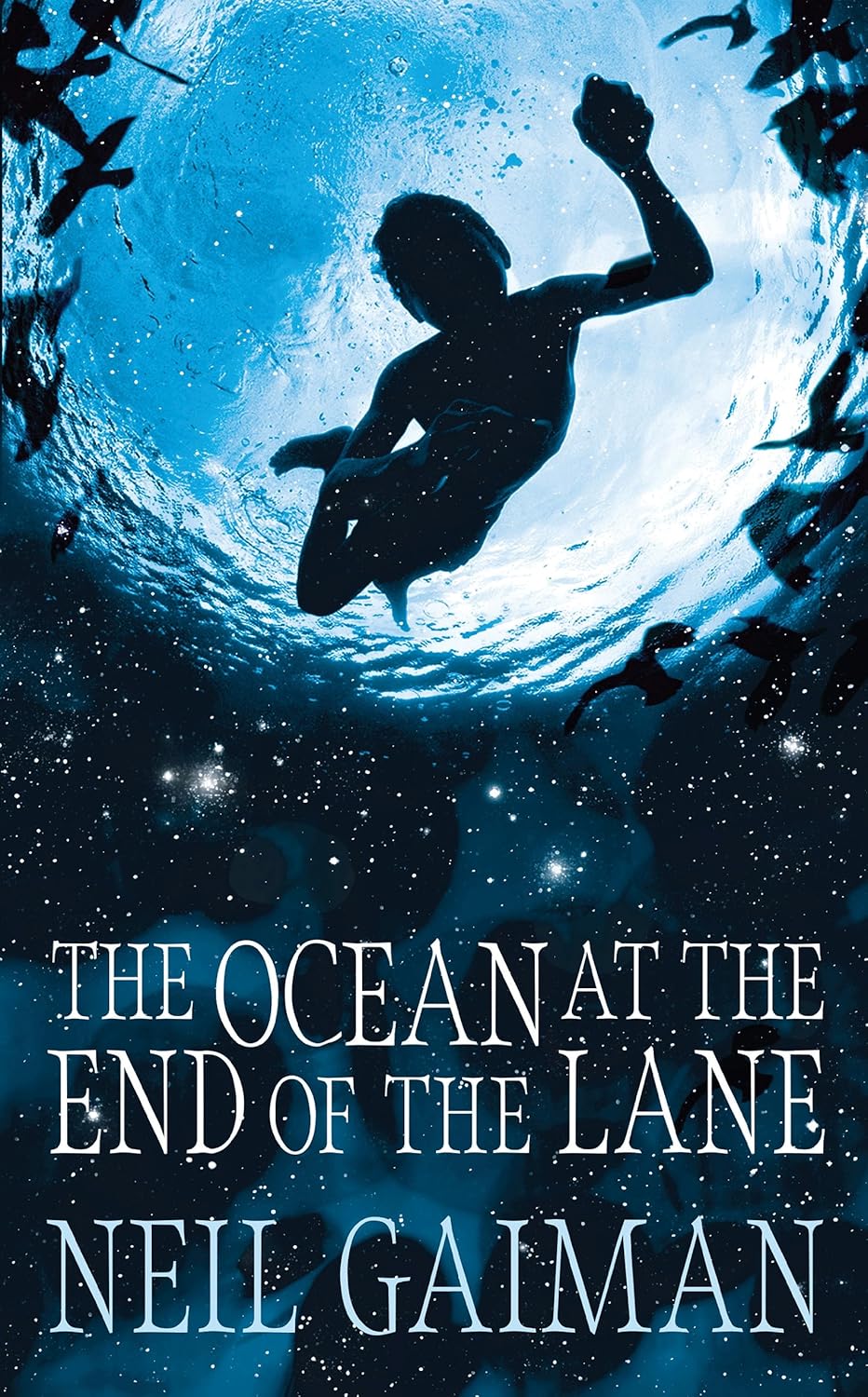
The Ocean at the End of the Lane - Neil Gaiman

Some books are a real pain in the bum to classify.  Those of you who read my review of The Book Thief may remember the mini-rant that I went on at those people that classify simply as a Young Adult book, but I do admit that applying such labels is not an easy task.  Bibliophiles are notorious for loving a good classification – my own book shelf is a triumph of division and sub-division – but sometimes its best to not think about these things too much. 

Some books can be placed, others defy labels.  Can a book written from the point of view of an adult ever be called a childrens book?  Can one written through the eyes of a young child be put in a general fiction shelf?  Neil Gaiman in his latest book The Ocean at the End of the Road certainly proves that the answer latter of those two questions is most definitely ‘Yes


The Ocean at the End of the Lane is the first book for adults that Gaiman has written for nearly a decade, and it follows a young, timid and lonely boy who, through death of his cat and the suicide of a man who was lodging at his house, find his world transfigured as a dangerous yet familiar looking demon attempts to take over his life.  While his parents and sister fall under its spell, he finds succour from a local family: three generations of women living together on a farm.  The Hempstocks are seemingly his salvation, but to really combat his demons the narrator must face them himself.
 
Continuing with the theme of labels, I would argue that though most people would call this a fantasy book, it really is a work of Magical Realism.   Indeed the only thing stopping it from being categorised as such really is that it is written in English and not the Spanish of the great Magical Realists such as Carpentier and García Márquez.  For me, the difference between ‘Fantasyand ‘Magical Realismis that in a magical realist book, the author weaves the magical into our world, one where most of the characters are blissfully unaware.  It must be rooted in reality, but have elements of the fantastic.  This precludes books like the Harry Potter stories, the Chronicles of Narnia or A Song of Ice and Fire as these are works of pure fantasy.

As the tale is written from the POV of a child, we are encouraged to read it through the eyes of ourselves as children.  It contains emotions and fears that when we were that young were very real to us: abandonment, loneliness, fear of the dark and unknown, yet also has many of the joys that we felt at that age: the inquisitiveness that so many of us lose as we grow old, the lust for adventure and the thrill of new friendships.  I have never read a book that so successfully expresses what it means to be seven years old before.  We were all that age once, but capturing it as adults is a very difficult task.  Gaiman has succeeded brilliantly, and this is the greatest joy of reading this book.

Like most books of this nature, though the story is about the fantastic, it is grounded in some very real and primal concepts.  The boys abandonment and even abuse by his manipulated parents brings a real element of terror into the story.  His family comes under the influence of a demon in the form of an attractive au pair named Ursula Monkton.  She terrifies and threatens the child, but the world of course is ruled by the adults so he is powerless to resist her.  The only way to fight back is to use the powers of the supernatural, and to unlock that he needs Lettie Hempstock: the girl at the end of the lane.

The book itself is quite short and was originally designed as a short story.  For me this is its only real weakness.  The book is really all one single episode and you really feel that it is all still just an elongated short story.  Perhaps a little sub-plot or two may have helped to flesh it out a little and could have made it even richer.

The entitled ‘Oceanof the book appears to the boy and to the rest of the world to just be a pond, but to the Hempstocks it is an ocean, a limitless expanse where one can transcend worlds – and that is a little about how I feel about this story.  It is like a time-portal, transporting us to a condition that we once inhabited and reminding us that while we all eventually grow-up, we must never forget what it was like to be young and alive.


8.5/10

Favourite Quotes

“Grown-ups don't look like grown-ups on the inside either. Outside, they're big and thoughtless and they always know what they're doing. Inside, they look just like they always have. Like they did when they were your age. Truth is, there aren't any grown-ups. Not one, in the whole wide world.” 

“Adults follow paths. Children explore. Adults are content to walk the same way, hundreds of times, or thousands; perhaps it never occurs to adults to step off the paths, to creep beneath rhododendrons, to find the spaces between fences. I was a child, which meant that I knew a dozen different ways of getting out of our property and into the lane, ways that would not involve walking down our drive.” 

“I liked myths. They weren't adult stories and they weren't children's stories. They were better than that. They just were.” 
Read More »

Friday, 30 May 2014

Gone Girl - Gillian Flynn

I’m not usually one for crime thrillers in either book, tv, or film form.  I generally find them to be rather samey, a mite predictable, and written by people with little-to-no actual experience of the things about which they are writing.  Occasionally though I break this fast, and when I do I generally find that it is rather brilliant.  Gone Baby Gone , Steig Larsson’s Millennium trilogy, and LA Confidential are some examples of the best parts of the genre.  When I first read The Girl With The Dragon Tattoo I thought that I had surely read the best crime novel that I would read.  I was wrong.


So much has been said about Gillian Flynn’s outstanding third book Gone Girl that it almost seems perfunctory to add to the huge expanse of praise being heaped upon it – but I am going to do so anyway.   After bingeing on this book it has rarely left my mind, and I could talk about it for  as long as the rain outside falls.  The really difficult thing is working out where to begin!

The premise of the book appears to be a classic missing-wife case.  The man, Nick, opens the book by relating how he discovered that his wife had gone missing on the day of their fifth wedding anniversary.  The second chapter then consists of an entry from his wife Amy’s diary relating how she met her future husband and these dual narratives eventually meet in the present.  This is not highly original, but I have never seen it accomplished with such skill.

I said earlier that this was a ‘classic missing-wife case’, but there is nothing predictable about it.  I found that a few of the twists and turns are rather telegraphed in the promotion of the book – even the back cover copy contains rather more plot points than I would like – so I am going to give you the bare bones here.  The central characters of the book, Nick and Amy, are two people that never should have married.  They are in essence: bad people, with personalities that were never going to coalesce, married for the wrong reasons, in a bad situation in their personal and professional lives.  The façade of the perfect marriage is shaky and falls apart on the merest pressure.

These main characters are beautifully developed and revealed through the story.  The impression that you have of them changes from chapter to chapter as the seeming perfect-wife Amy is revealed to be a spoilt, scheming brat and the noble Nick is shown to be the weak, damaged and compliant man he always was.  Flynn’s skill is in allowing you to make notions of who these people are and then just as you do so, revealing another facet which changes your perception.  It is a truly remarkable example of how one constructs character in fiction.

This story is disturbing – distressing at times – and some of the questions it raises and issues it digs up stay with you for a long time.  It’s one of those books that you devour in a single sitting and consider long after finishing.  I cannot remember the last time that I was quite so perturbed and fascinated by something so impressively written.

9/10

Favourite Quotes

“My mother had always told her kids: if you're about to do something, and you want to know if it's a bad idea, imagine seeing it printed in the paper for all the world to see.” 

“Friends see most of each other’s flaws. Spouses see every awful last bit.” 

“I feel myself trying to be charming, and then I realize I’m obviously trying to be charming, and then I try to be even more charming to make up for the fake charm, and then I’ve basically turned into Liza Minnelli: I’m dancing in tights and sequins, begging you to love me. There’s a bowler and jazz hands and lots of teeth.” 

“She’s easy to like. I’ve never understood why that’s considered a compliment - that just anyone could like you.” 
Read More »

Saturday, 26 April 2014

Racing Through the Dark: The Fall and Rise of David Millar - David Millar

You say the word ‘Tour de France’ to someone and the chances are that their minds won’t be drawn to the endurance, resilience and glory attached to cycling’s blue riband event; they will instead think of people like Lance Armstrong, Alberto Contador and Floyd Landis.  Drug Cheats.  There is no sport in the world that is more associated or blighted by the scourge of doping than professional road cycling, and it has brought the sport to its knees many occasions.  Heroes have been cut down and records rewritten as champion after champion has been revealed to have been under the influence of performance enhancing narcotics.  We now appear to have reached the other side of the tunnel, but the stain will never truly be removed.

One such man caught out was the British cyclist David Millar.  Before Bradley Wiggins and Chris Froome announced Britain as one of road cycling’s superpowers, Millar was the golden boy of UK cycling.  A Tour De France stage winner and a World Road Race Champion, he seemed destined for Olympic glory and maybe even to be Britain’s first ever Tour de France winner.  That was until in 2004 when he was arrested, admitted to taking EPO – a blood boosting drug – and was banned for two years. Racing Through the Dark: The Fall and Rise of David Millar is his story.

I have said before that I am not usually one for memoirs.  I generally find them self-serving attempts to justify the author’s actions which rarely offer any kind of genuinely interesting insight.  There are a few exceptions to this, and this book is definitely one of them.  Racing Through the Dark is an honest and sometimes harrowing tale of how the youthful idealism of a young up-coming cyclist can be eroded by the dark under-belly of a sport rotten to the core and in doing so asks some very real questions about how we treat dopers in modern sport.


David Millar is that rarest of beings: a drug cheat who came clean (admittedly while under arrest) and who did not spend years lying to the authorities and the world (see Armstrong, Landis etc).  The book is brutally honest – a truly introspective look into the ‘hows’ and ‘whys’ of doping.  He does not seek to excuse, merely to explain.  The book takes us from his early years of broken family and infatuation with the sport of cycling, through his amateur and professional career up to 2011 which was when the book was published.  Millar starts as a torch-bearer of the ‘clean cyclists’; someone who refused to dope even while nearly everyone else around him was, yet eventually he succumbed.  It is profoundly distressing to see such a man broken by the pressures and forces us to question what we would have done?  If the playing field is so tilted and your career depends on success, can you really justify not doping?  As he says: “If the riders, governing bodies, teams, race organisers and media weren't doing anything about it, then what the hell could I, a 20-year-old neo-pro from Scotland, do about it?”

Millar’s honest writing style makes this sometimes quite a hard book to read.  It is not particularly pleasant to see such a man fall in so ignominious a way – yet it is the only way that this book could function; no one wants to read a flattering account of a drug cheat.  So many memoirs are so heavily ghost-written that they contain little-to-no insight, or are so rose-tinted as to be completely opaque: not so this. 

Something that I found myself contemplating while reading the book was about the very system of punishment.  The reason for giving bans for doping is threefold: to deter would-be dopers by showing that their actions have consequences, to take them out of the sport so that clean riders have a fair shot, and to re-habilitate them back into the sport.  In this way it is much like the criminal justice system itself, yet the attitude pervasive in British sport in particular is very much a ‘throw away the key’ mentality.  What Millar represents in this book is a man for whom the system has – eventually – worked; a man reformed through a no-nonsense attitude in his national federation and through the humiliation of being caught and the consequences for his career.  It made me question my own ‘throw away the key’ attitude as well, and a book that makes me question my own beliefs in any way is certainly something worth reading.

This book may now be a little old, but it is still worth a read.   It tails off a little towards the end in his redemption arc, but that is the harshest criticism that I can give it.  Cycling fans in particular will love it, but the story of a flawed, fallen hero is so universal as to make it suitable to anyone.  Much like Millar’s career, it is not always easy but thoroughly worth it in the end.

7.5/10

Favourite Quotes

“The past is as important as the future, but we only live in the here and now.”

“The manner in which one loses the battle can sometimes outshine the victory.”

“What an idiot I'd been. What a spoilt brat. What a bloody fool.”
Read More »

Thursday, 10 April 2014

Life after Life - Kate Atkinson


In The Wizard of Oz, Glinda offers Dorothy some very sound advice: “It's always best to start at the beginning.”  This is not the vogue method in modern literature, with authors liking to start their stories at the end (The Book Thief), the middle (The Secret History) or in an undetermined part of the plot (The Time Traveller’s Wife).  Starting at the beginning has begun to see a little old-fashioned, unimaginative even.   What the latest book on my review list has done is go in the opposite direction, not only starting at the beginning, but going on to re-start at that beginning many times.  This is Kate Atkinson’s much praised new book Life after Life.


Life after Life is one of those books that grabs you right from the synopsis.  It is the story of a girl, Ursula Todd, who dies minutes after being born on a snowy night in 1910.  But what if she hadn’t?  The story briefly relates her death before moving onto this ‘what if’.  She later drowns in the sea as a small child, but what if this hadn’t happened?  This book, at its most basic level, is about these ‘what ifs’.  It is about how a life can be changed after making seemingly innocuous choices.  Ursula’s life shifts from dying during the Spanish Influenza, to an abusive marriage to a school teacher, to dying in the Blitz (several times) to being the wife of a high-ranking Nazi.  Upon every death we are brought back to snowy Middle England in 1910, but this repetitiveness does not become tiring, it grounds us in the new reality before the narrative moves on.

Ursula is dimly aware of these other lives, of her pre-incarnations, but is mostly powerless to stop her respective destinies.  Indeed this story is both a repudiation and confirmation of the very idea of destiny.  The fact that Ursula has multiple ends belies the fact that she is subject to the whims of fate.  Her choices – and the choices of others – set multiple wheels in motion and shows us just how powerless she – and we – are in determining the course of our own lives.  This is in my view the most interesting part of this novel: an examination of just how much control we have over our own fate.

This is the first of Kate Atkinson’s books that I have read, and I have to say that I was impressed.  Even though it has been critically praised, a work of this scope and ambition has always got the ability to divide as much as it pleases, and I can readily understand why some may dislike it.  It does require an investment in time, as it took me around 250 pages before I really understood what the book was about.  Some critics have criticised it for being just a more elaborate version of the Bill Murray film Groundhog Day, and while I can see how they came to this view, I have to disagree.  This book is far more than just a set of circumstances repeating themselves.

If you are looking for a gentle read on a warm summer’s eve then this is not it.  Urusla’s fates are rarely particularly contented, especially as they pretty much all lead to a premature demise.  She is one of the ‘golden generation’ of people whose lives were inextricably caught up in the First and Second World Wars and she struggles to escape either of them with her life intact.  Kurt Vonnegut in a piece giving advice to new authors recommends: “be a Sadist. No matter how sweet and innocent your leading characters, make awful things happen to them-in order that the reader may see what they are made of,” and Atkinson has really taken this to heart in this book.  Ursula, although the same person with the same personality, is shaped and bruised by the winds of fate in this story, and it is this brutal storytelling that compels the reader to keep going.  

This book is one about fate and destiny, and how despite the changing fortunes of Ursula in her many alternate lives, she is unable to plot her own course.  Merida in the Disney/Pixar film Brave dreams of taking her life into her own hands and ‘changing her fate’.  It is Ursula’s complete inability to do that is the cause of all the drama in Life after Life.  This was a tremendously ambitious project and one that I was worried that was impossible to pull off – but that I was largely proven wrong.  The story does take a while to get going and you have to have faith that the author will bring you round.  Once she does, it is an absolute treat.

8/10

Favourite Quotes

 “What if we had a chance to do it again and again, until we finally did get it right? Wouldn't that be wonderful?”

“She doesn't believe in dogs," Bridget said. "Dogs are hardly an article of faith," Sylvie said.”

“Her heart swelled with the high holiness of it all. Imminence was all around. She was both warrior and shining spear. She was a sword glinting in the depths of night, a lance of light piercing the darkness. There would be no mistakes this time.”

“Sometimes it was harder to change the past than it was the future.”

Read More »

Tuesday, 25 March 2014

The Secret History - Donna Tartt (Classic)

There is always danger when you read a book that has achieved a huge amount of praise.  Depending on the individual there can be the instinct to either: 1) Give it undue praise because other respected people have done so and to not reciprocate would make you sound like an ill-educated oaf, or 2) Try to stand out from the crowd and establish credentials as being ‘alternative’ by deliberately not liking it.  Even if one avoids these traps, it is not always easy to remain totally impartial when reading a new book, especially if it is acclaimed.  This, of course, is the central task of any reviewer, and though true impartiality is almost impossible to achieve, it is important to at least be aware of one’s possible frailties and limitations when reviewing something.

Donna Tartt is a very successful author with her latest book The Goldfinch being nominated for and won numerous awards including the prestigious New York Times ‘Top Ten’.  Her career, however, started in 1992 with The Secret History.  Now normally I only review new(ish) books, but this book came highly recommended by many people whose judgement I trust, and so I thought it would be appropriate to give it the full treatment.


The Secret History in many ways defies categorisation but the best that I have found calls it a ‘Whydunnit’.  The story begins by telling us about a murder, who the victim was, and who the perpetrators were.  The narrator appears to have ‘got away’ with the deed but feelings of guilt obviously linger.  This kind of approach where the ending is given away is not unique to Tartt of course – this was famously utilised by Shakespeare in Romeo and Juliet – but her application of it is particularly effective.  The murder itself occurs neatly in the middle of the story giving us half of a story explaining why the murder occurred, and the other describing the aftermath. 

The story focusses around a young man called Richard who comes from a working-class background to study at an elite university in the North-East of the United States.  There he discovers the most elite and selective course: Ancient Greek, which only taught to 5 students at that time.  These 5 were somewhat cut off from the rest of the university as their education was incredibly immersive and so naturally they were all close.  Ancient Greek culture and literature is one of the story's major themes, cropping up in the obvious context of their studies, but also in the make-up of many of the major characters.  I am in no way a student of Ancient Greek theatre, but one of the stories major characters, Henry, has been described in numerous sources as the classic Greek tragic hero, and it is easy to see how such a man would fit into the famous myths that even I am familiar with.

Almost all of the story takes place on the university campus, a place largely cut off from the ‘real world’ and so these characters, ostensibly cut-off from the rest of their contemporaries, find themselves in a world cut-off from a place already cut-off.  The first major development of the story is that Richard’s classmates, minus the eventual murder victim Bunny, accidentally perpetrate a terrible crime.  Both Bunny and Richard are made aware of this and react in divergent ways.  For Richard his loyalty lies to the people that gave him a sense of belonging and home, while Bunny – feeling cut off by the group who never truly accept him – finds it harder to ignore the crime.  This ultimately leads to his death, the major event in the story.

Donna Tartt is an exquisite writer, and this is much in evidence in this book.  This is described by many as a ‘literary’ book, and yet it is incredibly readable.  I have absolutely no time for writers who believe that to be taken seriously they must render their prose as clear as mud.  Tartt proves that you can write with skill, poise and character, whilst also making her meaning accessible to us mere mortals without literature degrees.  Her story has a natural beauty that is impossible to explain – which of course is the essence of true beauty.  The characters are rich and vivid without being caricatures and I can honestly say that the business of reading the story was an absolute pleasure.

Any avid reader of my blog (if they exist) will know that the aspect that I generally pull out from a story is the relationships between the characters, especially familial ones.  This book is no different as it is really a story of ‘found family’.  All of the characters seem incredibly detached from their parents and, in the case of the twins, even on occasion from their siblings.  The idea of the ‘found family’ is very strong here and the shifting dynamic between the friends as the situation in which they find themselves grows increasingly desperate is, for me, the central part of the story around which everything else revolves.  It is this that is the central frame of the story and allows Tartt to hang all of her beautiful description and embellishment.

Having said all of that, this is not the perfect book.  The stem of this novel’s limitations are that it suffers from a classic case of ‘First Novel-itis’.  I see time-and-time again that authors in their first published work go a little overboard in the breadth of coverage, including details and sections that do not really advance the story but are instead included to satisfy the author’s artistic temperament.  This is understandable, most authors have dreamt of being published for years and so the temptation to include the maximum level of detail must be great.  The Secret History is not immune to this problem, though it is largely located in the first half of the story.  This section still has the richness and beauty that permeates the rest, but it just takes forever to get going.  The pacing is just wrong and this is brought into sharp focus by the rest of the story which moves at a wonderful speed.

This issue, however, does not stop this from being a terrific book and one that I would recommend to anyone.  It is one of those books that anyone with an interest in literature must make a bee-line for and I look forward to reading some of Tartt's more recent titles.

8/10

Favourite Quotes“Beauty is rarely soft or consolatory. Quite the contrary. Genuine beauty is always quite alarming.” 

“Does such a thing as 'the fatal flaw,' that showy dark crack running down the middle of a life, exist outside literature? I used to think it didn't. Now I think it does. And I think that mine is this: a morbid longing for the picturesque at all costs.” 

“Some things are too terrible to grasp at once. Other things - naked, sputtering, indelible in their horror - are too terrible to really grasp ever at all.It is only later, in solitude, in memory that the realization dawns: when the ashes are cold; when the mourners have departed; when one looks around and finds oneself - quite to one's surprise - in an entirely different world.” 

“Any action, in the fullness of time, sinks to nothingness.” 
Read More »