Tuesday, 28 January 2014

The Rehersal - Eleanor Catton

I am usually intensely distrustful of 'literary' books.  I often find that they put showing-off ahead of telling a good story.  Clever writing techniques do not necessarily lead to good storytelling.  That is not to say that I am a total philistine – I just like my books to be understandable to those of us mere mortals without degrees in English Literature.  The truly great 'literary' books are those that use imaginative techniques and strategies to tell a story, rather than the story being incidental to those techniques.

Eleanor Catton's Man Booker Prize winning book The Luminaries was often damned in some quarters with the compliment "a triumph of style".  I have not personally read it myself, but knowing something of it, I can see how people may come to that conclusion.  This made me a little nervous about giving her debut novel The Rehersal a go, but having done some research I thought it worth a try.

Now first things first: a confession.  I like Ellie Catton (yes I did just call her Ellie).  I was actually interning at Granta Books when The Luminaries won the Booker Prize and had the pleasure of not only meeting her and her partner but we also all went out boozing together.  She is one of the nicest and most genuine people I have ever had the pleasure of meeting and I cannot rule out the possibility that this review may be influenced by her being a gem.


The Rehersal tells two parallel stories: that of an elite, slightly Darwinian, drama school and that of a high school in the grips of a teacher/pupil sex scandal.  All of the characters are like open books, like characters in a play.  They keep very little to themselves and articulate every emotion to each other in a very clear and evocative manner.  It is told in a constantly shuffling time scale, moving between months and years constantly, which makes the plot a little difficult to follow but equally keeping the story moving along at a good pace.  Catton never reveals anything too soon, always ensuring that you are kept guessing.

The central plot point: the affair between Victoria and Mr Saladin is kept secret and mysterious, just as it was to the students in the play and pupils at the school. For the girls at the high school, the affair was a great betrayal of their trust, not because it happened, but that Victoria did not tell them. In that community total secrecy was the taboo. Sex was seen as something that was both intimate between the people involved, but also that deserved public scrutiny - something that is interesting to consider in our world.  Moreover, the characters in the story celebrate crisis: being seen as damaged was desirable and the characters who identify as being 'normal' are outcast which is another really interesting thought that Catton throws up.

The storyline in the theatre school is a little less focussed.  While the descriptions of the lessons and attitudes of the teachers were my favourite parts of the book, I felt that it did not marry well with the rest of the plot.  The spine of the story are saxophone lessons given to many of the main characters by an unnamed teacher who has a seemingly unhealthy fascination with the lives of her young charges.  There is clearly some potent symbolism here, but I was not unable to unearth it: it was possibly a little over my head.


Though at times I felt the book to be a little over my head, I loved this book, especially how the characters are completely open with little thought of social propriety, and the examination it contains of teenage social interaction and life is truly something to behold. While this is not my usual genre, I would recommend this to any reader who is willing to dedicate some time and thought to a book.  Trust me, it is well worth it!

8/10

Favourite Quotes
“She is a loner, too bright for the slutty girls and too savage for the bright girls, haunting the edges and corners of the school like a sullen disillusioned ghost” 

“Remember that anybody who is clever enough to set you free is clever enough to enslave you.” 


“Gaining control isn't the exciting part. Sleeping with a minor isn't exciting because you get to boss them around. It's exciting because you're risking so much. And taking a risk is exciting because of the possibility that you might lose, not the possibility that you might win.” 

“The stage is not real life, and the stage is not a copy of real life. Just like the statue , the stage is only a place where things are made present. Things that would not ordinarily happen are made to happen on stage. The stage is a site at which people can access things that would otherwise not be available to them. The stage is a place where we can witness things in such a way that it becomes unnecessary for us to feel or perform these things ourselves.” 
Read More »

Friday, 17 January 2014

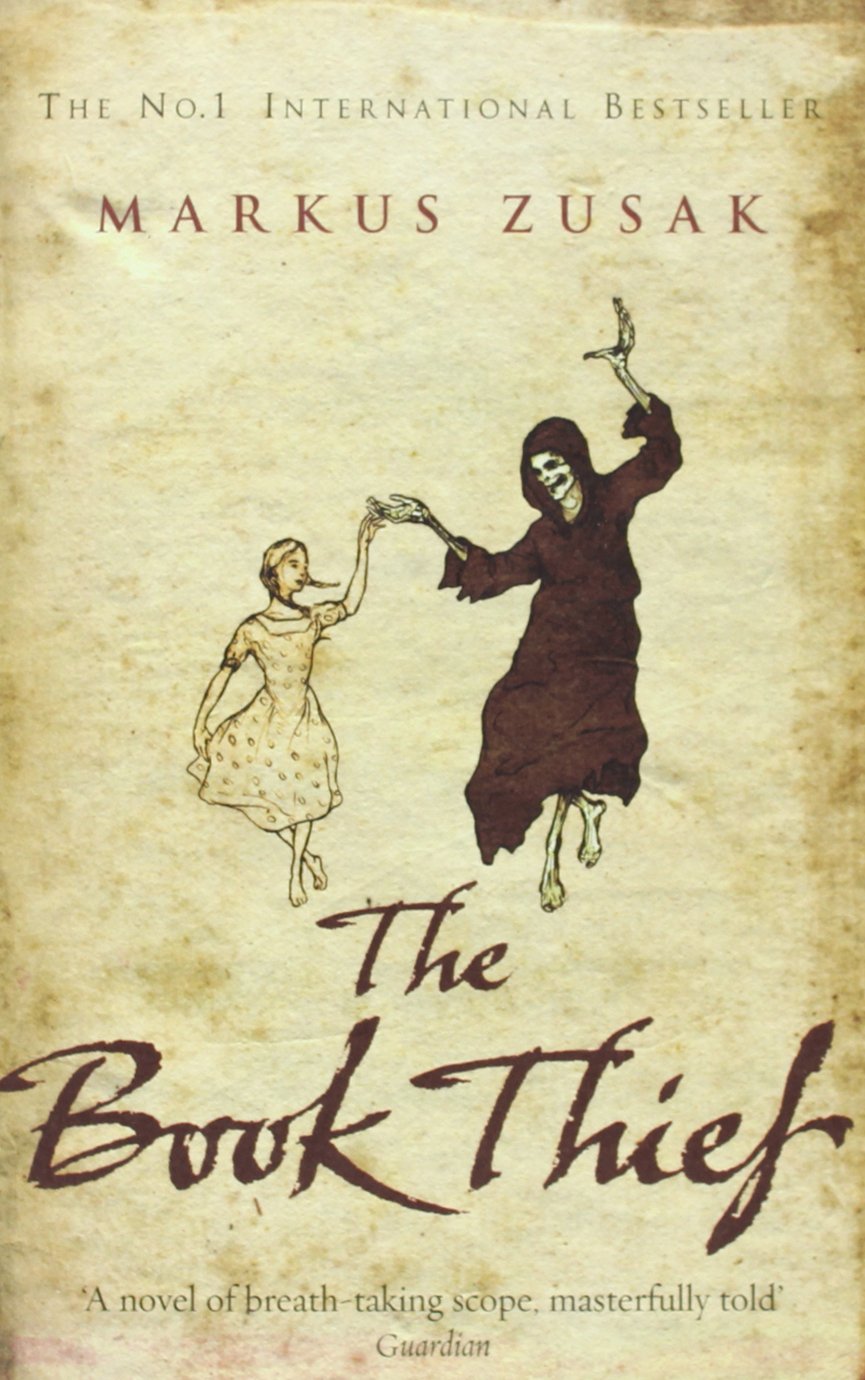
The Book Thief - Markus Zusak

There are some periods of history that are particularly fertile ground for works of fiction or film.  How many books have you read set during the Tudor and Georgian ages of England, the Civil War era of the United States, or Revolutionary France?  These are all times of either great extravagance and change or great violence and upheaval, and in these periods the author doesn't lay a lot of groundwork – we already know.  These settings come with the additional advantage of being in the (relatively) distant past, by which I mean that nobody alive today remembers it.  Yet there is one that is ubiquitously synonymous (at least in the Western world) with suffering, hate and death: Nazi Germany. 

A complete list of books, films and television programs set in Nazi Germany and during the Holocaust is really too long to set out here, but do include such masterpieces as: Schindler's List, The Boy in Striped Pyjamas, Sophie's Choice, The Pianist, The Reader, Life is Beautiful and The Damned.  This is illustrious company to have to match up to, and that is before one considers the moral responsibility to not sully one of history's great tragedies with a mediocre portrayal; it is quite another thing to produce something that not only reaches these lofty heights, but also exceeds many of them yet that is exactly what Markus Zusak does in The Book Thief.


Now I would like to start this review with a couple of personal peeves from other reviews: this is not a Holocaust book.  Yes: it is set in Nazi Germany during The Holocaust, and Yes: it does feature a family hiding a Jewish man in their house, and Yes: The book does deal with the repression and death associated with it BUT calling The Book Thief a Holocaust novel is like saying that 1984 is only state control over the behaviour of its citizens - it is a major theme, but it is about so much more than just that one facet.

I also have another peeve: this is NOT a YA book.  It does feature as its main character a child, but so does Child's Play and I'm not sure anyone is quite old enough to watch that!  While the character of Death does have somewhat of a sensitive and regretful sensibility, that doesn't have to make it YA.  For me, a YA book is one that is marketed at teens.  They generally feature a single main character dealing with the problems of youth and growing up.  They have first kisses and loves, friendship and familial relationships, and experimentations with new experiences.  The Book Thief, though you could at a pinch call it a coming-of-age story, and it does have familial relationships at its heart, is not this.  This is general fiction, marketed and read by all.

Anyway, enough with my rants - let me tell you a little more about this awesome book:

The Book Thief opens with a monologue written by 'Death'.  He talks about the Second World War period being a time of intense activity for him, a period where he was needed constantly.  He portrayed shown largely in the Grim Reaper representation, though he does talk about being rather amused by the archetype.  He then introduces the main character, a young girl by the name of Liesel Merminger, who is given up for adoption by her communist mother who knew that, in her care, she would never be safe.  She is sent to the Munich suburb of Molching to live with the kindly Hans and the foul-mouthed if loving Rosa Hubermann.  As a blonde(ish) Lutheran German pre-adolescent, Liesel is not at risk from persecution - but she still experiences the horrors of the Nazi state and the foreign and domestic wars it waged.

 Liesel is the eponymous 'Book Thief' and steals her first book, the unlikely 'Gravedigger's Handbook' at the cemetery during her brother's burial.  This becomes her link with the past, the only tangible connection to a mother she barely remembers and a brother whose death she dreams of daily.  Her later book thieving is for a very simple reason: to even the score.  She has lost so much – had so much taken from her – that taking books is, to her, the only rational response.  She develops a passion for words, yet it is also words that Zusak presents as being responsible for the death that surrounds her.  She finds herself enchanted by them and driven on just as Germany was enchanted by the words of Hitler.

One thing that really marks this book out is Zusak's style.  By having the story written by someone omniscient, he is able to do what I call 'Mean Intentional Spoiling'.  In this way he is able to tell you a character is going to die several chapters before it happens, which he uses to devastating effect.  You are always kept on your toes and you are never able to feel comfortable reading this book because you have no idea when Zusak is about to drop a bombshell on you, something that does literally happen at one point.  This 'spoiling' is a product of Zusak's style of jumping chronologically about, especially when relating the parallel stories of Liesel and the Jewish refugee Max.  This is done in often a fairly whimsical style but when the author wants to be brutal he does so without remorse

The Holocaust of course rears its head in the narrative, and the main way this is interacted with is through Max.  Max is the son of a soldier who saved Hans (Liesel's foster father) during the Great War and flees his home to the Hubermanns in the wake of anti-Semitic persecution.  He is hidden away from sight and his only interaction with the world at all is through Liesel.  They find that they are kindred spirits: orphans of hate, fascinated by the written word and haunted by their past experience.  They develop a powerful bond, and it is this that I think is the most powerful and beautiful part of the story.

And it is these bonds of friendship and family that are the most important ones in this story.  I haven't talked much about Liesel's relationships with her foster parents or her best friend Rudy because frankly I don't want this review to go on forever, but these relationships are vital.  If books form the trunk of this story, then it is the relationships that Liesel develops that are the flowers and blossom.  It is these relationships, that are borne through a shared suffering but also a shared hope, that are shown as being the most powerful.  In fact it is this friendship that in the end saves Liesel's life.


It should not come as any surprise to anyone having read this far that I absolutely loved this book.  It is not the easiest read, but it is a triumph.  It waded into a topic considered sacrosanct and a setting saturated by brilliant works, but yet it manages to rise effortlessly to the top.  It is quite simply, and utterly, brilliant.

Read it.

Read it now!


9/10

Favourite Quotes
  • "I have hated words and I have loved them, and I hope I have made them right."
  • "Trust me, though, the words were on their way, and when they arrived, Liesel would hold them in her hands like the clouds, and she would wring them out like rain."
  • "The consequence of this is that I'm always finding humans at their best and worst. I see their ugly and their beauty, and I wonder how the same thing can be both." 
  • "Somewhere, far down, there was an itch in his heart, but he made it a point not to scratch it. He was afraid of what might come leaking out."
  • "I guess humans like to watch a little destruction. Sand castles, houses of cards, that's where they begin. Their great skills is their capacity to escalate."
Read More »

Friday, 10 January 2014

Walk Me Home - Catherine Ryan Hyde

We live in a society that demands leadership; that is in love with decisive action.  If you go to your local bookshop and look at any book on self-help title, that's what it'll tell you to do.  Make your mind up and make a decision!  The my favourite one is from Teddy Roosevelt: " In any moment of decision, the best thing you can do is the right thing, the next best thing is the wrong thing, and the worst thing you can do is nothing."  The problem is that most of us are wrong about most things most of the time.  Of course we are, it's how we learn.  What happens though if life-or-death decisions about your life, and that of your little sister are thrown to you when you're just 16?  Well I imagine you'd say you'd be screwed.  Well, that just about summarises my latest book:


Walk Me Home is the latest book by Catherine Ryan Hyde, though it is the first of hers that I have read.  Straddling the divide between YA and Adult Contemporary, it tells the story of Carly and Jen: two sisters who are travelling from New Mexico to California on foot as they flee towards the only responsible adult they have ever known in an attempt to avoid going into care.  Their father is long-since gone, their mother is recently gone (for reasons that are explained later and I will not spoil), and the only adult left in their lives is Teddy - a man who Carly loves and trusts beyond all else, but Jen has reasons to say otherwise - who lives hundreds of miles away and is uncontactable.  They had no money, no transport and frankly no hope. 

After escaping starvation and assaulty/rapey adults (and some nice ones as well) they find a cranky yet kindly old American Indian woman who takes them in despite her catching them stealing from her hen house.  Jen is a fan, Carly is not, leading to the sisters splitting before fate intervening to reunite them at the end.
 
The first thing that I would say about this book is that you have to suspend that part of your brain that tells you that this realistic or believable.  The plot is frankly a little ridiculous and the characters it has to be said are hardly original.  However, there are good facets to this book that I did enjoy.

The first is the drip-drip nature of the story telling.  It is written in a flashback style, with part of the story being told in the present, and the other being about six months in the past.  This means that at the start you have no idea why the girls are fleeing or what it is they are fleeing from.  As the plot progresses then the pieces of the puzzle begin to fit together and you start to build the picture, but just as the girls are confused about what is going on, so is the reader.  they don't know who to trust or who to believe, and likewise neither do you.  To quote Blackadder : "it twists and turns like a... twisty turny thing".

The second facet that I liked brings me back to what I was talking about at the start.  Responsibility was thrust upon Carly as the elder sister but, just like Lizzie Bennet in many ways, she is blinded by her own prejudices.  She hates her mother and doesn't believe a word she ever said.  She implicitly trusts Teddy despite mounting evidence to suggest he is a ne'er-do-well.  She insists on trusting no one else and on keeping on travelling, despite appearances that that may be a little suicidal.  With Carly it's her way or the highway (in fact its more her way AND the highway).  She is incredibly tunnel-visioned, and that is both what keeps her and Jen alive, but also what leads them into great danger.  She doesn't know who to trust, so she trusts no one but Teddy.  While this may not be a terribly original character, she is a very interesting one as she is intensely flawed.

This is in many ways a classic coming-of-age story with a very readable style which never reveals too much; keeping you hooked.   It is a story about 'Home' and where to find it when your life is seemingly lost.  It is a tale of hope and optimism in the face of crushing odds which pushes all of the emotional buttons with more twists than a Cornish country lane.  It's faults are many, focussed around the fact that most of the characters fail to act in any sense rationally, but this does not stop this from being an enjoyable read.

7/10
Read More »

Saturday, 4 January 2014

Unbreakable - Kami Garcia

Anyone who has been to university knows that there are two basic academic groups: the Science students and the Arts students.  There are of course some subjects that straddle this great divide such as Psychology, Geography etc but these are the main two.  Now I hope you will please indulge me if I be a little broad and sweeping.  

In general Science students like facts, numbers, theories, equations.  They like something tangible; something that they can follow so that they can add ‘x’ to ‘y’ and get ‘z’.  They like to ask questions and get definite answers, or at least some kind of an answer – preferably one that can be expressed in a few words.  

Arts students, myself included here, do not like this.  We don’t answer questions: we like to say things like “well to an extent that is true but really there are a number of factors...” We like to pooh-pooh so-called facts, saying lines like “facts get in the way of a good narrative.”  Now this is of course because the kinds of questions that we tackle are not the same: they are creations of man, not of nature.  You can come up with an equation to figure out how fast something falls or what time the Sun will rise in the morning, but you can’t create one to explain what makes Mozart’s music enchanting or JRR Tolkein’s works enthralling.  You can’t express art through numbers, be it music, painting, sculpture or literature, yet this has not stopped people from attempting to work out the formulas to the perfect book – the 5 easy steps to telling a best-selling story – and in my view, Kami Garcia has attempted to do just that.


I won a copy of Kami Garcia’s first solo book Unbreakable from a competition on Goodreads.  I entered the contest not really bothering to work out what it was about, just because I fancied a free book.  The cover of it made it look a little silly but it was free so who cares right?  The book is a YA supernatural story about a girl named Kennedy who was living the kind of life that 14 year old female protagonists of YA books always lead: alone, boyfriendless and angsty about it, bookish and devoted to her parents (or in her case parent).  Her life is suddenly torn apart when a demon, latched onto her cat like a plague flea on a rat, kills her mother and she is only saved by a pair of dashing twins who tell her that she was descended from a secret order of, in effect, demon hunters.  

So we have the stereotypical protagonist, in a stereotypical-ish plot and now we are going to hit new levels of lack-of-imagination: the twins.  They are both teenage boys but have different characters: one is level-headed and sweet but a little dull; the other is handsome, dashing and damaged.  Care to hazard a guess where the love interest of this story lies?  Oh these three are not alone.  We also have the bitchy, fightery girl who sees the protagonist as a liability, and the nerd, the technical support guy who is no threat to the protagonist and is merely there to provide cool things.  

The plot, other than a lot of angsting around, is about demon/ghost hunting, specifically about preventing a powerful demon from escaping into our world and it is up to our motley band of barely trained teenagers to do it.  Think Ghostbusters but 15 years old and with worse stuff.  And meaner demons.

I think you so far get at why I think this book isn’t great: it’s as formulaic in structure and characters as the speed of light.  Indeed the plot, up until the end at least, is so incredibly predictable that anyone in any sense familiar with YA literature could tell me the entire plot from a small number of clues.  The characters in many ways are caricatures, not over-blown in any sense but just perfect tropes.  I won’t spoil the plot for you, but frankly you could guess most of it from here.  The ending is actually quite good and rather salvages the overall plot into something rather decent, but really this book, while not riddled with faults, suffers from the very basic problem that it is entirely formulaic.  It is as if Kami Garcia had distilled every YA book that she had ever encountered into a mathematical formula, created an algorithm, inserted the names of each character trope that she wished to include, and pressed “Go”.

The book is not badly written, nor is it a terrible read: it is just bland as all hell.  You finish the book and feel very little from having completed it because you feel that you have already read it before.  It is incredibly lazy storytelling and in some ways makes me a little pissed off because I have no idea why this was published.  Books these days are churned out in their  tens of thousands every year and yet the industry is still struggling and it will continue to struggle if all they produce is mediocre, middle of the road, formulaic works such as this.  This books really is one of those times where I wish that it had been bad – if it had been bad then at least it would have been original.

4.5/10
Read More »

Monday, 23 December 2013

The Ballad of the Five Marys - Donald Smith

Sometimes when you’re an intern at a publishing house you get questions that you really don’t know how to answer.  These are questions like: “How are you finding your time here?”, “Would it be okay if I asked you to do...” and “Isn’t this cover that I designed fabulous?” which all have very nice and easy answers.  You say: “It’s great, I’m having an amazing time”, “Of course, nothing would please me more” and “It’s beautiful!” and to be honest most of the time you are being truthful because every person that I have worked with so far in this industry has been incredibly friendly and talented.  On occasion, however, the tricky questions come up., the most difficult of which is: “What do you think of this book?” Now this is more than a question of sucking up to the powers that be. You can’t of course be wholly negative, but a sycophantic response praising the book to the rafters is not always appropriate either. You’re trying to show off judgement, taste and maybe a bit of a discerning sense of where the market is.  This means that the normal response is to praise the book but offer reservations. 

Where am I going with all of this?  Well near the end of my first placement with Luath I was given Donald Smith’s The Ballad of the Five Marys to proof-read.  This is a historical-fiction novel set during the life of Mary I of Scotland (the inner historian in me hates calling her Mary Queen of Scots for boring reasons that I will not get into here).  I read through much of the book in one day and was asked how I was finding it.  I, truthfully (often a mistake in work and in love), said that I was really enjoying it and thought it could be, if marketed right, a big seller.  Apparently this was the correct answer (phew!) as the book was quite popular in the office.  However, on describing the novel to some of my friends I have found that people have been quite sceptical about it.  Therefore the purpose of this review really is going to be me attempting to persuade you that this book is, in fact, a really rather excellent historical novel set in a period saturated with a lot of very average works.

The main reason for why I like this book is the style.  Unlike other genres of fiction, I find that historical fiction tends to be a little stuck in its ways. Most books tend to be written in a fairly standard first-person style, focussing on one or two characters’ journey or in a narrative third-person style. This book is nothing like that at all.  It is set throughout most of the life of Mary Stewart, first crowned regnant-Queen of Scots from the time of her birth to her incarceration by Elizabeth I of England.  The story is told through a number of POV accounts, set through a combination of diary/diary-like accounts, personal correspondence and other similar methods.  The idea essentially is to get a widow on the minds of each individual.  The ‘Five Marys’ (four companions of Mary I along with the queen herself) have their own shared diary, form around half of this, the rest being various people from like Darnley and Bothwell.  The author has a strong didactic purpose (something that I will come back to later) and this means that he attempts to get as many different perspectives in as possible, but this does not distract from the story-telling – in fact I believe it enhances it greatly.  As a historian with an interest in the period I am perhaps not the best person to talk about with regard to how the characters come across, but in my view they are differentiated well without becoming generic and all bring their own distinctive flavours to the story.  Equally, one would expect a story that covers such a significant amount of time to rather flounder as time passes, but quite the contrary, I find it picks up pace as the story progresses.

This story’s main weakness, however, lies in its didactic purpose.  The author professes himself to be a big fan of Mary Stewart and intends for the novel to redress the balance of some professional historiography that, in Donald Smith’s view, unfairly maligns her.   For me this is a rather troubling stance to take.  It is true that modern historiography has often shown Mary to be a rather naive queen, whose poor choices in husband led Scotland to a very bloody period of civil strife that dogged not only her reign but also the minority of her son James.  Furthermore, there is a very valid argument that perhaps this line of enquiry can be overplayed; Mary ruled at a very difficult time thanks to the emerging power of England and the turmoil of the Reformation.  Having said all of that, however, for a fictional account to be attempting to pass itself off as some sort of amateur history strikes me as being a little troubling.  It strikes me as being a bit like films such as BRaveheart that have very little grounding in actual history, but pass themselves off as fact.  Now this book has far more accuracy than Mel Gibson’s mauling of history, but it must always be remembered that this is fiction.  Leave history to the pros!  The worst example of this is the final page which lists a group of ‘Discussion Questions’ which seems to suggest that Smith intends for this book to be taught to children in school as History.  I really hope that is not the case as it would mark a remarkable dilution of the subject for a fiction book to be passed off as fact!

Despite this reservation, I would strongly recommend this book to fans of historical-fiction, if nothing else than because stylistically it is so different from anything I have read before in adult fiction.  Ignore the pretentions of historical scholarship and you will find a very pleasing read!

7/10
Read More »

Thursday, 19 December 2013

Animal Lover - Raymond Friel

My reading choices in the last few weeks may seem a little eclectic, they certainly have seemed that way to me!  The reason for this mix of different book styles is that I am currently doing a lot of internships at various different publishing houses and a large part of most of these is reading.  A LOT of reading!  Some of what I have read has been good, some not so but that I suppose is the nature of the beast. 

The latest book that has crossed my path was a very unusual offering by a first-time author called Raymond Friel whose debut novel Animal Lover has recently been published by Luath Press.  This curious book was given to me on my first day at Luath to proof-read and I was informed by the boss that it was one of her favourites from this year.  Eager to impress her with my knowledge and to misguide her with spurious statements about by skill in the task set before me, I set about proofing this manuscript.  Animal Lover is a story about a lovable animal rights activist named Danny.  Danny’s life is a bit of a mess, but he does have his little gang of freedom fighters who seek to liberate animals from man’s oppression.  Sadly, an operation to free some dogs from a laboratory goes badly wrong and for complex reasons, the dogs have to be thrown off the roof.  This rather tears apart his group, especially a girl that has recently caught his eye who goes off to join some more hardcore, more terroristy groups.  Things don't really go much right for Danny from there-on-in


The book is written in a narrative style with a very unusual method of writing direct speech which, once you get your head around it, is perfectly understandable but I wish he wouldn’t do it - it seems rather pretentious and unnecessary to me to mess with grammatical rules for no real purpose.  The style is very informal and quite irreverent which fits the narrative well and allows for the absurdities of the plot to come through.  These absurdities make this novel a real hoot to read – I provided some great amusement for many of my colleagues as I occasionally burst out laughing at random points – and it is clear that Friel has a real aptitude for this kind of writing.  The characters are engaging and occasionally surprise you with little gems of conversation that bring the story alive and the book is short enough that the whole thing rollicks nicely.

Having said that, however, the length is this novel’s most significant problem (other than the stupid method of writing direct speech). Well, more specifically, it’s the ending that bothers me. The story builds up to a rather terrific climax, but it all ends rather too quickly. It’s not that there’s no closure, no pay-off as such for completing the book. It’s just that, considering the book has been building up to this big ending at ‘The Circus’, you’d have expected this to last more than just a few pages. It’s all rather frustrating really because it almost spoils the book. I have always said that the mark of a good writer is being able to get the reader/viewer to the end of the story and for them to care for the characters; the mark of a great writer is being able to bring together all the strands of the story and bring them to a pleasing conclusion.  Friel so so nearly does that, but he bottles it with an ending that had promise, but was just not nearly long enough. It’s almost like it was an exam essay and he found that, after spending his first hour and a half writing the first half of the book, he only had 30 minutes to write the rest.

Having said all of that, there is no doubt that this is a very fun read, something that I would recommend to anyone wanting to read something quite different and that will make them laugh.  There is definitely something Douglas Adams-y about Friel and that, in my book, is high praise indeed.


7/10
Read More »

Friday, 22 November 2013

'S' - JJ Abrams and Doug Dorst

We are always told not to judge a book by its cover.  This is sometimes given as a fairly broad piece of advice telling us not to judge things upon face value or on a purely aesthetic level, and on other occasions it is much more simply that, just because a publisher hired a talented cover artist, it does not necessarily follow that the author has actual talent and/or readability.  This advice is genuinely good and I wish that more people would take notice of it; to judge to quality of a person’s character on the attractiveness of their face/size of various body parts is patently ridiculous and I like to think that most of us realise this.  There is a sizeable problem with it sadly – I like pretty things.  I like to be able to look at my book shelf and be filled with that wonderful sense of wonder and superiority when I acknowledge that I am a proud owner of many beautiful books.  Recently, however, the bar was raised in this field with quite possibly the most stunning book that I have ever held: the rather unassumingly named S.


S is a collaborative work written by J.J. Abrams (yes the guy that is in charge of Stars Wars and Trek) and Doug Dorst (not really famous at all).  Attempting to explain this book is really a rather complicated task as it is really two books within one single tome.  The backbone of the story is a story called ‘The Ship of Theseus’ supposedly written by a mysterious author called V.M. Straka.  This is the story in the traditional sense in that it is written in chapters in the place where you would expect the story to lie.  Yet in reality this is not where the true narrative lies: it exists in the annotations and messages shared between two people in the margins of the story.  It is their story that is most interesting, and it is this that makes this story truly special.


So this is a standard page in the book. As you can see there is the traditional text in a standard typed form and the annotations in the margins. The sections in cursive are written by the girl, Jen, and the ones in capitals are by the guy, Eric. The colours are also significant the notes were not all written in one sitting or one read-through. So the bits in blue/black are the first chronologically with the orange/green coming next and so on. 

Now this makes this story a rather complicated one to read.  Do you read the main story first? Do you read them together?  Do you ignore the main story and just focus on the annotations? Personally I just focussed on the annotations.  Initially I tried to read both at the same time but I quickly worked out that the main story was really just a vehicle, a taxi really that provides a launch-pad for the story of Jen and Eric.  Their story is also two-fold.  The first is academic, to find out who V.M. Straka was. Straka seems to be a figure who makes Salinger look like David Beckham and there is apparently considerable debate as to who he was.  The elusive Straka also was involved in some distinctly shady events during his life and he left a dark legacy that places both Eric and Jen in considerable danger.  Added to this, perhaps predictably for something written by Abrams, there is a love story as Jen and Eric gradually fall for each other.

In addtition to this are the inserts. Every now and again you will find a little something place between the pages of the book.  Sometimes its a letter written between Eric and Jen, something too long and personal to put in an annotation.  Othertimes its a newspaper cutting or a postcard.  One time it is a not written on a napkin.  These are my personal favourite things; they are what makes this book so beautiful and special.  These inserts turn the book into a little treasure chest and add a sense of wonder to the joy of reading.  It reminds me of reading those little pop-up books as a kid, when the story would come alive in a very visual and tactile way.  Except now I'm old - but it's still awesome!

The production quality of this book is sensational - it truly is a beautiful thing to behold.  The effort that the publishers have gone to produce everything to do with it is remarkable.  The story of Jen, Eric and the pursuit of Straka is told in a wonderful drip-drip manner, keeping most of the information back while hinting at it through the mixed-up chronology.  It is a truly unique reading experience, and one that I am sure I will revisit very soon

9/10
Read More »

Friday, 8 November 2013

13 Little Blue Envelopes - Maureen Johnson


Anyone that knows me will tell you that I am not a picture of heroic masculinity.  Put me in any situation that involves typically manly pursuits (jar opening, Nazi fighting, press-upping, not crying at musicals) and I will fail faster than Starbuck in a sanity contest (kudos to all that get the reference).  My taste in literature has often been criticised for its girliness not to mention my taste in music, interior decoration and alcoholic beverages, yet even with this propensity, I found my latest book a little challenging.

13 Little Blue Envelopes is a book written by Maureen Johnson and actually by now it is pretty old.  Well actually that isn’t really fair but it was published in 2005 which is, for me, a long time ago – especially given the fact that I usually review books written within the last few years.  Maureen Johnson is famous(ish) to those of you of an American persuasion but I had not heard of her at all until very recently.  My introduction into the world of American Young Adult fiction (largely avoiding stories involving teen vampires) first took me to the world of John Green and through his books I discovered his amazing Youtube channel that he runs with his brother Hank called the ‘Vlogbrothers’.  Now many of you will be intimately familiar with it and will be screaming at me HOW DID IT TAKE YOU THIS LONG TO FIND OUT ABOUT IT??? Well to those people I can only say, I was probably busy playing Football Manager, because that is probably an accurate summary of most of my free time as a teenager.  Anyway (this post is taking even longer than usual to get to the point), through them I was introduced to Maureen Johnson’s books and after some brief Amazoning (surprised that isn’t a verb yet) I decided to start with 13 Little Blue Envelopes.

This is a story about an American girl called Ginny who receives in the mail 13 envelopes, from her recently deceased aunt.  Her aunt is a classic bohemian arty type who has eschewed the rather conservative nature of her family to go gallivanting around Europe.  The first of these letters gives Ginny a credit card with some money and tells her to book a flight to London, leaving all electronic devices behind.  She can only bring one rucksack and can’t bring any maps/guidebooks etc with her and has to open each envelope only after accomplishing each task contained in the previous one.  This leads her on a crazy trip around Europe, seeing her visit, amongst other places: London, Edinburgh and Paris.  The trip itself is a journey of discovery for Ginny in two ways: learning about the life of her aunt and also finding out more of who she is and what she can do whatever misgivings that she may have.

Now, this book is very clearly not marketed at me – I mean it is more closely marketed to me than say a 70 year old ex-navy veteran with a penchant only for whisky and stories involving hard-core nudity – but even so I am clearly not the intended audience here.  My first clue really should have come from the cover.  Generally books aimed at boys are a little less pink (though to be fair she is grasping her thighs in a rather suggestive manner...) The point is that this book is meant to be read by girls like Ginny Blackstone: nervous, timid 14 year old American girls who are trying to find out who they are and want nice boys to like them.  I can’t blame Maureen Johnson for this, those people make up about 80% of the standard readership of YA books.  Normally this is not much of a problem.   I mean I was never an American girl but I can at least identify with the nervous timid bits and even if I could not, the human imagination is a wonderful thing.  Good books manage to appeal to a wide readership, giving everyone no matter who they are a little thing to grab hold of and identify with and the problem with this book is that it doesn’t quite manage that.  The major problem is found in the middle of this book where Ginny falls rather hopelessly for a university drama boy called Keith.  She falls in love in much the same way that Juliet falls for Romeo – hopelessly without much regard for finding out anything about him – and it is at this point the book starts to develop some severe angst, which, in my view, came dangerously close to ruining it.  A little romantic tension is fine, but this was very stereotypical girl-angst, familiar to anyone who has ever been on Myspace (a reference that anyone who wasn’t born between about 1987-1993 is unlikely to get).  This got in the way of what was a rather interesting story and threatened to turn it into something that more closely resembled Twilight fan fiction.

Luckily, this was only a part of this story and it did have many other excellent features.  My personal favourite was the description of Ginny’s time in London – and this is where this book not being aimed at me actually comes full circle and becomes an advantage.  Any Londoner will be familiar with the hilarity that is American tourists.  You can spot them a mile off normally as they are invariably 1) Lost, 2) Wearing shorts in inappropriate weather, 3) Wearing walking-trainers, 4) Loud.  Now Ginny is not all of these things but she rather superbly acts the part of tourist in my city.  She gets baffled by Tube ticket machines (seriously I see this all the time and I have no idea why it is so hard to understand), confused by Harrods (I’m actually with her on this one) and confused by how Ribena works (I had no idea that squash could confused people but apparently this is a real confusion for some non-Brits).  Her experience as a tourist in all these cities, not just mine, made me laugh a lot and in general this was a very funny book, mostly intentionally.

I find that Young Adult books normally – more than other genres – tend to contain significant life lessons; something edifying for its predominantly teenage audience to ponder over after finishing.  This story is mostly about self-belief and finding that there is much more to yourself than you may give credit for.  Ginny spends most of the book saying how she wishes how she was ‘more interesting’, that she had more ‘stories’.  Now this is despite the fact that she followed her aunt’s instructions throughout the book without question, some of which were really quite dangerous in retrospect.  While the teen girl-angst was present, that was not the dominant force of the narrative (thankfully) and it is this part of the story that I most enjoyed.  This was not a moral that was stuffed down your throat.

6.5/10

Favourite Quotes

“She was standing in the airport of Copenhagen, staring at a doorway, trying to figure out if it was (a) a bathroom and (b) what kind of bathroom it was. The door merely said H.
Was she an H? Was H "hers"? It could just as easily be "his". Or "Helicopter Room: Not a Bathroom at All”

“I like you because you were mad. And you're pretty. And pretty sane for a mad person.”

"No shoe should be judged by its footprint, for the foot has a print of its own."
Read More »

Sunday, 3 November 2013

A Captain's Duty - Richard Philips and Stephen Talty


I have a longstanding distrust of memoirs. I generally feel that they are rather clever ways that people find to make money off bragging about themselves.  I also find that they are frequently heavily ghost written, especially if they appear to have been written within a couple of months after the author achieved something of great note.  A classic example of this is Bradley Wiggins’s autobiography which came out *cue shock and astonishment* a few months after he won the Tour de France and Olympic gold and just in time for Christmas.  Reading it was akin really to listening to a publicist with a few more swear words, it was dreadful.  Exceptions to this rule tend to come from people who have a background in media or in writing in general.  These include the autobiographies of Stephen Fry and Tina Fey both of which are full of home-truths, self-reflection and are genuinely interesting reads.

A Captain’s Duty therefore should have set off all of the alarm bells. This is a memoir written by a man with no background in writing, which was originally published a year after the hijacking which provides the backbone of the story and it even credits the ghost writer, Stephan Talty.  The only time that a ghost writer gets such a prominent credit is when he essentially wrote the entire thing.  Nonetheless I thought that I’d give it a go.  Afterall it has pirates, a thrilling rescue and Barack Obama – what more could one want in a book?

For those who are not familiar with the background to this book I shall provide a short synopsis.  In April 2009 a cargo ship captained by Richard Philips was captured by Somali pirates.  The ship’s crew and its captain managed to engineer the situation so that the pirates only escaped with the captain himself aboard the ship’s lifeboat.  Therein occurred a stand-off between these pirates and the US navy which was ended when navy SEALs stormed the boat, killing the captors and rescuing Captain Philips. Hooray!

Now for the sake of argument I am going to assume, with a pinch of salt, that what the books says is broadly true.  There have been numerous suits by members of Philips’s crew that the book contains not so much facts as a huge tin of whitewash, acquitting Philips of charges of incompetence and even collusion with the pirates.  It is not for me to make a judgement on that, I shall let the great legal minds of the US deal with that.  However, I will say that this book very quickly irritated me as very quickly the author started bragging.  He presents himself as this macho authority figure who rose from the wrong side of the track to become the ideal family man as well as leader of men.  His wife loves him, his children worship him, and his men respect and fear him. His account of what happened on the boat reads very much like a film script (shockingly it has now been turned into a film starring Tom Hanks) and really it seems to be an exercise in the author crawling up his own backside and giving it a good licking.  It does all seem too good to be true.  There is very little introspection and what self-admonishment there is is severely played down.

That is not to say that it is not a well-written book.  It paced very well and contains plenty of action.  There are parts of it that really do seem like they come from a film script and the scenes are easy to imagine and relate to.  It’s odd because this seems like a really negative review when actually I did quite enjoy much of the book.  The issue I have with the book is, however, extremely pervasive and gets in the way of me being able to, in good conscience, recommend that you buy it.  If, having read this, you feel that you can get past the issues I describe then by-all-means give it a go.  You’ll probably like it.

5/10

Read More »